Education
How to Learn a New Language: A System That Sticks


The best way to learn a new language is to build a repeatable system around the situations you actually need to handle—not to collect apps, memorize random word lists, or chase a vague idea of “fluency.”That is the central problem most language advice misses: a learner can study for months and still be unable to complete the exact conversation that motivated the effort in the first place.
Current high-ranking guides are largely right about the basics. They emphasize consistency, comprehensible input, early speaking, useful vocabulary, and regular exposure. The weakness is that those ideas are often presented as separate tips. A stronger approach connects them into a loop: define the target situation, notice useful language, understand it, retrieve it from memory, use it in a new situation, receive feedback, and repeat.
That loop also fits how modern proficiency frameworks think about language ability. The Council of Europe’s CEFR describes proficiency through “can-do” performance across communicative activities rather than by study hours alone. Recent second-language research likewise continues to treat input as central while showing that instruction, feedback, and deliberate attention can shape what learners notice and produce.
This guide turns those ideas into a personal system. It covers goal design, language variety, pronunciation, phrases, vocabulary, grammar, input and output, feedback, micro-immersion, progress measurement, a weekly schedule, a 90-day roadmap, and the trade-offs most “learn fast” articles oversimplify.
What Does It Actually Mean to Learn a Language?
Learning a language means being able to understand and communicate in the situations that matter to you. That sounds obvious, but it changes what should be measured. Knowing 2,000 flashcards is not the same as understanding a customer on a phone call. Completing 100 app lessons is not the same as writing a clear email or recovering when a speaker says something you missed.
A useful working model has three connected activities: input, output, and feedback. Input is what you understand through listening and reading. Output is what you produce through speaking and writing. Feedback is what helps you notice where your current version differs from a clearer, more natural, or more accurate one. Retrieval links all three because knowledge becomes usable only when you can produce it without looking at the answer.
Start With a Language-Learning Specification
Before choosing resources, write a one-page specification. “Become fluent” is too broad to guide Tuesday evening. A specification forces you to decide what the language is for, which situations matter first, how much time is available, and what success would look like.
| Decision | Weak version | Useful version |
| Purpose | Learn Spanish | Handle customer calls in Spanish |
| Situation | Conversation | Greeting, clarifying an order, confirming delivery |
| Target | Be fluent | Hold a 15-minute work conversation without switching languages |
| Deadline | Someday | Six months |
| Time | Study more | 25 minutes on weekdays + 60 minutes on Sunday |
| Evidence | Finish lessons | Complete a recorded role-play and get understandable feedback |
Use the future-conversation test
Write three conversations you expect to have: one within 30 days, one within three months, and one within a year. Then extract the vocabulary, phrases, grammar, pronunciation, cultural knowledge, and repair language each conversation requires. This becomes a personal curriculum.
This approach also fits a broader principle in personal development: capability improves faster when the goal is specific, observable, and connected to repeated practice rather than vague self-improvement.
Choose the Right Version of the Language
Many beginners choose a language without choosing a primary variety. That creates avoidable confusion later. Spanish differs across Spain, Mexico, Argentina, and other regions. Arabic learners face an even bigger strategic choice between Modern Standard Arabic and regional spoken varieties. English learners may need different pronunciation, spelling, or workplace conventions depending on where they will use it.
Choose one primary model for speaking and listening. Learn to recognize major alternatives later. The goal is not to claim that one variety is “correct”; it is to give your ear and mouth a stable reference while your system is still forming.
- Choose by destination, workplace, family, media, or conversation partners.
- Keep pronunciation and listening input mostly consistent for the first months.
- Learn regional alternatives as recognition vocabulary before trying to actively produce every form.
- If the language uses multiple scripts or registers, decide which one your target situations require first.
Build a Sound Map Before Expanding Vocabulary
A learner can know how a word looks and still fail to hear it in real speech. That is why pronunciation should begin before vocabulary becomes large. The aim is not accent erasure. It is to create reliable links between sound, meaning, and production.
The record–compare–adjust loop
- Choose one short sentence from a reliable native or highly proficient source.
- Listen for rhythm, stress, vowel length, linking, reductions, and intonation—not just individual consonants.
- Record yourself saying the sentence.
- Compare one feature at a time and change only that feature.
- Record again, then use the same sound pattern in a new sentence.
This is more useful than repeatedly reading pronunciation rules without hearing your own output. During the first week, build a short list of unfamiliar sounds and stress patterns, then revisit them inside real phrases.
Learn Phrases, Not Just Isolated Words
Single-word learning helps recognition, but conversation happens in chunks. A useful vocabulary entry includes the word, one natural phrase, pronunciation, common partners, a likely reply, and the situation where it is used.
For example, “appointment” becomes more usable when learned through “make an appointment,” “move the appointment,” “I’m running late for my appointment,” and “Does Thursday work?” The learner is building a network, not a translation pair.
Prioritize vocabulary by value, not frequency alone
Frequency matters, but a generic corpus does not know your life. Rank vocabulary by three questions: how common is it, how relevant is it to your situations, and how soon can you use it? A moderately common phrase needed every day at work can be more valuable than a globally frequent noun you rarely need.
- Core words: common verbs, pronouns, connectors, time expressions, question words.
- Personal words: family, work, hobbies, routines, location, preferences.
- Situation words: travel, meetings, healthcare, shopping, interviews, study.
- Repair language: “Could you repeat that?”, “Do you mean…?”, “Let me try again,” and “How would you say this naturally?”
Learn Grammar as a Set of Meaning Decisions
Grammar is easier to use when it answers a communication problem. Instead of memorizing a complete tense table, ask what choice the structure helps a speaker make. Is the event finished? Is it repeated? Is it still connected to the present? Is it background information? Is the speaker being formal, neutral, or casual?
Use minimal contrasts
Create two sentences that differ in one feature, then explain what changed in meaning. “I have lived here for three years” and “I lived there for three years” force attention onto the time relationship rather than the label of a tense. Small contrasts train noticing without turning grammar into an abstract syllabus.
When a grammar explanation feels confusing, use the same evidence-checking habit described in Aperplexity’s critical thinking exercises: state the rule you think you understand, find examples that support or challenge it, and revise the rule until it predicts real usage more reliably.
Balance Input, Output, Retrieval, and Feedback
Input matters because learners need repeated exposure to sounds, words, grammar, and discourse patterns. A 2024 Cambridge overview of second-language input describes input-based learning as central to acquisition while also noting that instruction can direct attention to selected features. The practical implication is not “listen passively forever.” It is to combine understandable input with tasks that force prediction, retrieval, and reuse.
| Method | What it does well | What it can miss | Best role in a system |
| App lessons | Structure and repetition | Spontaneous speech and individual feedback | Short daily review or beginner grammar |
| Flashcards | Fast retrieval practice | Context, pronunciation, interaction | High-value phrases with audio and examples |
| Movies/podcasts | Natural listening and culture | Can become passive entertainment | Short replayable segments with prediction and summary |
| Tutor/partner | Interaction and feedback | Cost, scheduling, inconsistent correction | Weekly mission, role-play, targeted correction |
| Reading | Vocabulary, grammar patterns, depth | Does not automatically build listening or speaking | Graded input plus phrase extraction |
| AI conversation | Low-friction speaking practice | Feedback quality and naturalness vary | Extra rehearsal, not sole authority |
Use the listen–pause–predict–continue drill
- Listen to a short dialogue you can mostly follow.
- Pause before a response.
- Predict what the speaker may say.
- Continue listening and compare.
- Reuse one phrase in a new answer of your own.
That single exercise combines listening, grammar, vocabulary, conversational prediction, and output. It is a better use of ten minutes than switching among four apps without a clear learning objective.
Design a Feedback System That Does Not Kill Fluency
Practice without feedback can stabilize repeated errors, but correcting every sentence can make speaking slow and stressful. The solution is selective feedback. Recent research syntheses continue to treat corrective feedback as a mature field with meaningful effects that vary by method, context, and learner.
- Immediate correction: use for a target sound or grammar feature you are deliberately practicing.
- Delayed correction: use during free conversation so communication keeps moving.
- Self-correction: pause and try again before receiving the answer.
- Pattern correction: track repeated errors rather than every one-time slip.
Turn an error log into future practice
Keep four columns: what you said, a better version, why it changed, and the next practice prompt. Do not collect everything. Track errors that are frequent, important, or easy to fix. Then convert each repeated mistake into five prompts that force the correct form to reappear.
This is where feedback becomes a learning engine rather than a red-ink archive. The log should create tomorrow’s speaking and writing tasks.
Create Micro-Immersion Without Moving Abroad
Immersion is not a country. It is the density of meaningful encounters with the language. A learner can increase that density by attaching language use to existing routines instead of trying to convert an entire life overnight.
- Breakfast: listen to one short dialogue and replay it once.
- Commute or walk: shadow five useful phrases aloud.
- Cooking: narrate actions and ingredients.
- Work break: read one short article or message in the target language.
- Before bed: write three sentences about the day.
- Hobby time: follow creators, forums, or tutorials related to something you already care about.
The hidden advantage of micro-immersion is decision reduction. The practice is attached to a cue, so motivation does not have to recreate the plan every day.
Plan for Conversation Before You Feel Ready
Many learners postpone speaking until they believe they have enough vocabulary. That creates a paradox: the skill they want is the skill they keep avoiding. Begin with predictable conversation frames and repair language. A beginner does not need unlimited vocabulary to ask for repetition, clarify a meaning, describe an unknown word, or restart a sentence.
Prepare short stories about yourself, work or study, family, routine, a recent experience, interests, and future plans. Those topics recur in early conversations and reduce the mental load of inventing content while also decoding the other person.
If the language goal is career-related, Aperplexity’s interview questions guide is a useful model for building reusable evidence rather than memorizing dozens of scripts. The same principle works in a new language: prepare a small bank of stories and learn to reshape them for different questions.
Measure Ability, Not Study Time
Study time is an input. It tells you that practice happened, not what the practice produced. The CEFR’s can-do approach is useful because it shifts attention toward communicative performance. You do not need to formally test at every level to borrow the idea.
| Metric | What to record weekly | Why it matters |
| Speaking span | Longest clear answer before switching languages | Measures usable retrieval, not recognition |
| Listening accuracy | Key details understood from a 60–90 second clip | Shows whether sound-to-meaning mapping is improving |
| Response speed | Time to answer five familiar questions | Reveals automaticity |
| Repair ability | How often you successfully ask for clarification and continue | Measures resilience in real conversation |
| Writing task | One practical message, email, or summary | Shows grammar and vocabulary under production pressure |
| Mission success | Completed real-world task with notes on breakdowns | Connects study to the learner’s original purpose |
Run one weekly language mission
Choose a task such as leaving a voice message, ordering something, explaining a problem to a tutor, writing a short email, summarizing a video, or asking three follow-up questions. Record the result and one change for next week.
For written missions with hard length limits, a simple tool such as Aperplexity’s word counter guide can help separate the mechanical constraint from the language task itself.
A 30-Minute Daily Study Plan
A compact session works when each minute has a job. The following pattern prevents the common mistake of spending all available time consuming new material.
| Time | Activity | Example |
| 5 min | Retrieve | Recall yesterday’s phrases without looking |
| 8 min | Understand | Listen to or read a short piece of new input |
| 10 min | Produce | Retell, role-play, answer prompts, or write |
| 5 min | Feedback | Correct one pronunciation, grammar, or wording pattern |
| 2 min | Plan | Choose tomorrow’s prompt from the error log |
If only 15 minutes are available, keep the same structure and shrink the blocks. Do not remove retrieval and production; those are often the first things busy learners sacrifice, even though they expose what is actually usable.
A Practical 90-Day Roadmap
Days 1–30: Build the operating base
Choose the primary variety, map difficult sounds, learn greetings and repair phrases, build a core phrase bank, and practice short predictable conversations. The target is not “A1” as a label; it is the ability to introduce yourself, ask basic questions, understand familiar phrases, and survive simple breakdowns.
Days 31–60: Expand situations
Add daily routines, past and future events, preferences, requests, and explanations. Use short native-speaker content with transcripts and keep one regular feedback source. The target is to speak about familiar topics for several minutes and understand the general meaning of slower real-world speech.
Days 61–90: Increase independence
Retell stories, explain problems, write practical messages, listen longer without subtitles, and practice recovering from misunderstandings. The target is to complete useful tasks with less translation and to keep a conversation moving when you do not know a word.
Common Strategies That Need Better Boundaries
“Just use an app”
Apps are good at structure and repetition, but most cannot be the entire system. Give the app one job—such as beginner grammar or spaced review—and add real listening, production, and feedback.
“Memorize the 1,000 most common words”
Frequency lists are useful, but they are not a personal curriculum. Learn common words inside phrases and mix them with the vocabulary required by your real situations.
“Watch shows for immersion”
Passive entertainment can expose you to natural language without producing much retrieval. Use short sections, replay them, predict lines, repeat selected phrases, and summarize what happened.
“Speak from day one”
Early speaking is useful when the task is controlled enough to succeed. Forcing an absolute beginner into a chaotic conversation with no survival phrases can create noise rather than learning. Start with rehearsed frames, then widen the interaction.
“Study every day”
Consistency helps, but streaks can become a proxy. Missing one day matters less than repeatedly avoiding the skills that are hardest. A five-minute speaking drill may be more valuable than protecting a 200-day streak with an easy exercise.
The Future of Language Learning in 2027
Language learning in 2027 will likely become more personalized, more conversational, and more instrumented—but not automatically better. AI voice systems can make speaking practice available on demand, generate role-plays, adapt difficulty, and create targeted prompts from an error log. That reduces the friction of finding practice, especially for learners without local conversation partners.
The risk is feedback authority. A system can sound confident while giving unnatural wording, weak cultural context, or inconsistent corrections. Learners should treat AI as a high-frequency practice partner, not as the sole judge of correctness. Native or highly proficient speakers, qualified teachers, trusted dictionaries, corpora, and official proficiency frameworks will remain important reference points.
A second trend is performance-based learning. The more tools can track speech, listening, writing, and revision, the easier it becomes to measure concrete tasks instead of raw lesson completion. That direction aligns well with the CEFR’s action-oriented emphasis on what a learner can do. The best systems will probably combine automation with human judgment rather than replacing one with the other.
Key Takeaways
- Define the conversations and tasks you need before selecting apps, textbooks, or courses.
- Choose one primary regional variety for speaking and listening, then add recognition of alternatives later.
- Train the sound system early so written vocabulary connects to real speech.
- Learn high-value phrases and sentence patterns, not isolated translations alone.
- Use input, output, retrieval, and feedback as one loop rather than four unrelated activities.
- Measure can-do performance—conversation length, listening accuracy, repair skill, writing tasks, and missions—not only hours or streaks.
- Review the system weekly and change the weakest link instead of adding more resources.
Conclusion
How to learn a new language becomes much easier to answer once the goal stops being “fluency” and becomes a set of situations you want to handle. Build the system backward from those situations. Learn the sounds you need to recognize, the phrases you need to retrieve, the grammar choices that change meaning, and the repair language that keeps communication alive when something breaks.
Then create a weekly loop: get understandable input, produce language, receive selective feedback, log repeated errors, and test yourself with a real task. That system is less exciting than a secret shortcut, but it is more honest and more adaptable.
Different languages, native-language backgrounds, schedules, and goals will change the exact mix. What should stay constant is the evidence standard. Progress is not the number of lessons completed. It is the growing range of things you can understand, say, write, clarify, and recover from in the language you chose to learn.
Frequently Asked Questions
What is the fastest way to learn a new language?
The fastest realistic route is to combine high-value input with frequent retrieval, early controlled speaking, and regular feedback. “Fast” depends on the language, the learner’s prior languages, available time, and target level. A focused system built around real situations usually beats a scattered routine that uses many resources without measuring performance.
How can I learn a language by myself?
Use one structured resource for sequence, one source of understandable listening or reading, a phrase-review system, and a way to produce language aloud or in writing. Add feedback through a tutor, exchange partner, teacher, or carefully checked AI practice. Self-study works best when it still includes outside feedback.
How do I practice speaking a foreign language alone?
Retell short stories, describe your day, answer recorded prompts, shadow a sentence, role-play both sides of a predictable situation, and record yourself. Compare one feature at a time—word choice, grammar, pronunciation, rhythm, or clarity—rather than trying to correct everything at once.
How should I learn vocabulary effectively?
Learn fewer items in richer contexts. Store a phrase, a natural example, pronunciation, common word partners, and the situation where it is used. Mix common vocabulary with personally relevant words and repair phrases. Retrieval from memory matters more than repeatedly rereading a list.
How long should I study a language each day?
A sustainable 15–30 minutes can be productive if it includes retrieval and production, not just new lessons. More time can accelerate exposure, but quality and consistency matter. The right daily amount is the amount you can repeat while still giving attention to listening, speaking, reading, writing, and feedback.
Should I use subtitles when learning a language?
Yes, but use them deliberately. Target-language subtitles can help connect sound and spelling. Native-language subtitles can help when material is otherwise incomprehensible, but they can also pull attention away from the target language. Rewatch short segments with less support over time.
Can AI teach me a new language?
AI can provide conversation practice, role-plays, explanations, corrections, and personalized drills, but it should not be the only authority. Check important corrections against reliable dictionaries, teachers, native or highly proficient speakers, and established language references, especially for nuance, register, and cultural use.
Methodology
Research for this article was conducted on October 6, 2026. A representative current top-10 search sample for the focus query and close variants included Babbel, VAEYC, Lejnel, SPAIKING, LanguageTool, LinguExcel, Lingoda, OpenLearn, Hayzoom, and Rosetta Stone. Search results vary by country, personalization, device, and index freshness, so this is a competitive snapshot rather than a claim of one permanent global ranking.
The recurring competitor strengths were consistency, motivation, comprehensible input, high-frequency vocabulary, immersion, speaking practice, and app/tool suggestions. The less consistently covered gaps were choosing a language variety, building a pronunciation sound map early, designing a curriculum around future conversations, turning errors into future prompts, measuring communicative ability instead of study time, and integrating all activities into one feedback loop. The article structure was built around those gaps rather than mirroring any competitor’s section order.
Factual validation prioritized the Council of Europe’s CEFR materials for performance-based proficiency, John Truscott’s 2024 Cambridge overview of input in second-language acquisition, and recent Cambridge/Elsevier research syntheses on corrective feedback. Internal destinations were verified as live through current web search. No firsthand learning experiment was performed for this article, so first-person testing claims are intentionally absent.
References
Council of Europe. (n.d.). CEFR descriptors. Retrieved October 6, 2026.
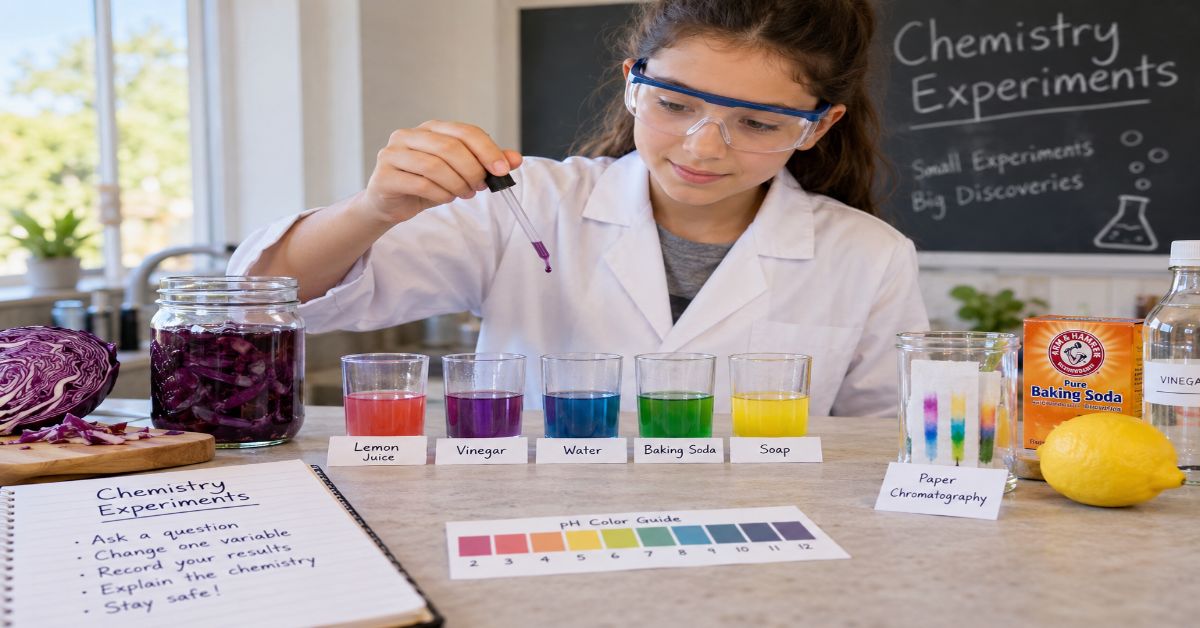
Chemistry Experiments are most useful when the reaction is not the point—the thinking is. A dramatic foam column may look memorable, but a simple color change can teach more if you can identify the variable, measure the result, explain the chemistry, and repeat the test safely. That is the gap I found after reviewing current high-visibility pages for this keyword: many offer long lists of “cool” activities, while safety level, measurement, and the difference between a demonstration and an experiment are often treated as afterthoughts.
The practical answer is straightforward. At home or in an ordinary classroom, choose small-scale activities built around food-grade or familiar household materials, avoid flames and concentrated chemicals, and use adult supervision where heat or glassware is involved. In a formal school or college laboratory, experiments can go further—but only with trained supervision, appropriate personal protective equipment, risk assessment, labeled reagents, and an approved waste plan.
I organized this guide by what a learner can actually do with the result. Each activity has a chemistry concept, a variable worth changing, a measurement worth recording, and a safety boundary. That makes the page useful to a child trying a first pH indicator, a high-school student preparing a lab report, and a teacher deciding whether an activity belongs on a kitchen table or behind a laboratory bench. The goal is not to make chemistry look dangerous or tame. It is to make the learning visible.
What Makes a Chemistry Experiment Worth Doing?
A good chemistry experiment answers a question with observable evidence. The strongest activities let you predict an outcome, change one variable, record a result, and connect that result to a chemical idea such as acidity, solubility, reaction rate, energy transfer, or electron flow.
That is also why inquiry matters. A 2025 study of the MICRO project found that moving away from traditional “cookbook” laboratory work increased the use of higher-inquiry activities that more closely resemble scientific practice (Van Wyk et al., 2025). The same principle appears in real-world learning: a 2025 general chemistry curriculum study reported more positive student perceptions after laboratory work was tied more explicitly to practical applications (Sokic-Lazic et al., 2025).
Start With Safety: Home Activity or Laboratory Experiment?
I use one rule before I look at materials: decide the setting first. The American Chemical Society’s current school chemistry guidance recommends risk assessment through RAMP—Recognize hazards, Assess risks, Minimize risks, and Prepare for emergencies. That is more useful than calling an activity “safe” in the abstract because risk changes with concentration, quantity, heat, pressure, glassware, ventilation, and the learner’s skill.
For home use, do not improvise with laboratory reagents, do not heat sealed containers, and never mix bleach with ammonia, acids, vinegar, or other cleaners. Experiments involving concentrated hydrogen peroxide, flammable solvents, metal salts in flames, reactive oxidizers, or unknown powders belong outside a casual home setting.
| Setting | Appropriate activity | Typical controls | Stop and escalate when… |
| Home / elementary | Food-grade indicators, dissolving, paper chromatography, simple crystals | Adult supervision; eye protection when splashing is possible; small quantities | The activity needs flame, pressure, concentrated peroxide, strong acid/base, or unknown chemicals |
| Middle / high school classroom | Structured investigations with approved school chemicals | Teacher risk assessment, goggles, labeled reagents, trained procedures | A procedure creates toxic vapors, uses flammables, or needs a fume hood / specialized disposal |
| Formal laboratory | Titration, calorimetry, microscale reaction analysis, analytical techniques | RAMP assessment, PPE, SDS access, emergency equipment, waste plan | Training, engineering controls, or disposal route are not in place |
Six Low-Risk Chemistry Activities for Home or Classroom
These activities are intentionally modest. Their value comes from the question you ask and the data you collect, not from maximizing the visual effect.
1. Red Cabbage pH Indicator
Red cabbage contains anthocyanin pigments that change color as acidity changes. Prepare an indicator with adult help using warm water and cabbage, then test small samples of familiar liquids such as water, lemon juice, and a baking-soda solution. Keep cleaning products out of the experiment.
Measure or vary: Change the dilution of one test liquid. Record the indicator color against a simple reference scale.
Chemistry concept: Acids, bases, indicators, qualitative measurement.
2. Paper Chromatography With Washable Marker
Place a small dot or line of washable marker on chromatography paper or a coffee-filter strip, then let water travel upward from below the ink mark. Different dye components move at different rates because of their relative attraction to the paper and solvent.
Measure or vary: Compare marker brands or colors while keeping paper size, solvent depth, and starting position constant. Measure how far each color band travels.
Chemistry concept: Mixtures, separation, polarity, capillary action.
3. Temperature and Dissolving Rate
Add equal amounts of sugar to equal volumes of cold, room-temperature, and warm water. Stir each sample the same way and time how long visible crystals take to disappear. This is a useful physical-chemistry investigation because it separates the rate of dissolving from the idea of a chemical reaction.
Measure or vary: Temperature is the independent variable; dissolving time is the dependent variable. Repeat trials rather than trusting one run.
Chemistry concept: Solutions, kinetic molecular theory, experimental control.
4. Casein Plastic From Milk
With adult supervision, gently warm milk and add a small amount of vinegar. The acid changes conditions around milk proteins, causing casein to separate as curds that can be filtered and shaped after cooling. This is a memorable bridge between food chemistry and materials science.
Measure or vary: Compare equal milk volumes with different vinegar amounts, but avoid turning the task into a tasting activity. Record curd mass only after using the same draining time.
Chemistry concept: Proteins, precipitation, polymers, materials chemistry.
5. Crystal Growth From a Saturated Solution
Dissolve salt or sugar in warm water until the solution is near saturation, then allow it to cool and evaporate slowly in a labeled container. Crystals form as dissolved particles organize into a solid structure when the solution can no longer keep all of the solute dissolved.
Measure or vary: Compare cooling location or evaporation rate while keeping concentration and container size as consistent as possible. Photograph crystal growth at the same time each day.
Chemistry concept: Solubility, saturation, nucleation, crystal structure.
6. Lemon Battery and Electron Flow
Two different metals inserted into a lemon can form a simple electrochemical cell. The lemon juice acts as an electrolyte, while oxidation and reduction at the electrodes create a small potential difference. Use only low-voltage measurement equipment intended for classroom use; never connect the setup to household electricity.
Measure or vary: Compare one fruit type at a time or measure voltage from cells connected in series under teacher or adult guidance.
Chemistry concept: Oxidation-reduction, electrodes, electrolytes, electric potential.
A useful extension is to ask how the same chemistry scales into living systems. For example, Aperplexity’s biodome guide explains why water chemistry, gas exchange, nutrients, and controlled environmental variables become connected inside an engineered ecosystem.
Three Supervised Chemistry Investigations for the Lab
A formal laboratory adds precision, but it also adds hazards and responsibilities. The following are appropriate themes for trained school or college settings; reagent selection and exact procedures should come from the institution’s approved protocol, not an improvised web recipe.
7. Acid-Base Titration
A titration uses a solution of known concentration to determine the concentration of another solution. Students practice volumetric measurement, endpoint detection, stoichiometry, and uncertainty. The learning gain comes from comparing repeated trials and deciding whether concordant results are actually good enough—not merely reaching a color change.
8. Microscale Reaction Analysis
Spot plates and drop-scale work can demonstrate precipitation, gas formation, neutralization, and redox chemistry with far less reagent than traditional test-tube volumes. A 2024 “On-the-Go Lab” paper described microscale aqueous-reaction activities as a secure, affordable and more environmentally efficient way to support learning while reducing reactant use (Davila-Diaz, 2024).
9. Calorimetry and Energy Change
Calorimetry links temperature change to energy transfer. In a teaching lab, students can measure the temperature response of an approved dissolution or reaction and use mass, temperature change, and heat capacity to estimate energy. The important skill is uncertainty: heat loss, cup insulation, measurement timing, and incomplete transfer can all shift the result.
What Does Current Chemistry-Education Evidence Suggest?
Hands-on work is not automatically superior to every digital alternative. Chen et al. (2024) found that, for a junior-high conservation-of-mass unit, a virtual-lab group performed better on knowledge measures while a hands-on group showed stronger overall inquiry performance, especially planning and evidence collection. The sensible conclusion is not “virtual versus real”; it is to use each environment for what it does well.
Safety instruction also affects learning. Hensley, Burrows, and Galerneau (2024) reported improved cognitive outcomes and positive engagement after students repeatedly used RAMP-based risk assessment in an organic chemistry laboratory course. In other words, safety reasoning can be part of chemistry learning rather than a checklist completed before the learning starts.
That philosophy is echoed by laboratory-safety author Robert H. Hill. In a 2025 C&EN interview about the free third edition of Laboratory Safety for Chemistry Students, he said, “Chemistry is really important to do,” while arguing that better safety education should help research rather than stop it. C&EN’s report on the free ACS safety e-textbook also reported that almost 70% of fall-2024 field testers thought the resource changed how they instructed students about chemical safety.
How Do You Turn a Cool Demo Into a Real Experiment?
The fastest upgrade is to replace “What happens?” with “What changes when I vary one factor?” I use a five-part structure: question, prediction, variable, measurement, explanation.
- Write one testable question. Example: How does water temperature affect the time needed for a fixed mass of sugar to dissolve?
- Change one independent variable. Keep container size, liquid volume, solute mass, stirring method, and timing rule as consistent as possible.
- Choose a measurable dependent variable. Time, mass, distance, temperature, voltage, pH, or number of drops are stronger than “looked bigger.”
- Repeat trials. A single result may reflect random variation, inconsistent technique, or measurement error.
- Explain the pattern with chemistry, then name at least one limitation. A good lab report separates what you observed from why you think it happened.
| Question | Independent variable | Measurement | Why it is stronger than a demo |
| How does temperature affect dissolving? | Water temperature | Seconds to dissolve | Produces comparable numerical data |
| Which marker mixture separates most? | Marker brand / color | Distance of dye bands | Connects visible pattern to separation |
| How does dilution affect indicator color? | Sample concentration | Color category / pH estimate | Tests a chemical trend |
| How does cell arrangement affect voltage? | Number of electrochemical cells | Volts | Links electron flow to a measurable output |
For school assignments, record raw data and notes before polishing the prose. If a teacher sets a strict report length, Aperplexity’s word-counter guide explains why counts can differ between tools and why the final submission platform should be the deciding count.
Keep draft history as well. Aperplexity’s AI text detector guide makes a useful academic-integrity point: automated authorship scores are screening signals, while notes, sources, version history, and human review provide stronger provenance.
Risks, Trade-Offs, and Common Experiment Mistakes
- Spectacle can hide the learning goal. If students cannot say what changed, what was measured, or what evidence supports the explanation, the activity is probably a demonstration rather than an investigation.
- Household does not mean harmless. Cleaning products, concentrated peroxide, drain chemicals, fuels, aerosols, and improvised heating can create toxic gas, fire, pressure, or splash hazards.
- More reagent rarely means more learning. Smaller-scale work often cuts cost, waste, and exposure while still producing observable chemistry.
- A perfect-looking result can be scientifically weak. Repeated measurements, uncertainty, controls, and honest reporting matter more than matching an expected answer.
- Virtual labs solve some access and rehearsal problems, but they do not fully replace technique, tactile feedback, cleanup, instrument handling, or physical risk judgment.
Skill improves through repeated, specific practice: measuring to a mark, reading a meniscus, timing consistently, labeling samples, and recording data before interpretation. Aperplexity’s practical personal-development framework uses the same useful idea outside the lab—turn a broad goal into observable actions with feedback rather than relying on motivation alone.
The Future of Chemistry Experiments in 2027
The most credible 2027 trend is not bigger reactions. It is better-designed experiments using less material, stronger measurement, clearer risk reasoning, and more purposeful digital support. Recent work on ultramicroscale and microfluidic chemistry shows how microliter-scale platforms can reduce reagent consumption while supporting green chemistry, inquiry, and interdisciplinary learning (Xu & Cai, 2024).
I also expect blended lab design to keep expanding. A virtual environment can let students rehearse sequence, interpret data, or explore a scenario that is difficult to repeat physically; the real lab can then focus time on manipulation, observation, troubleshooting, and evidence collection. The 2024 hands-on-versus-virtual study supports that complementary model rather than a winner-takes-all approach.
Sensors will make more beginner experiments quantitative. Low-cost temperature probes, pH sensors, color analysis, and digital voltage logging can turn an activity from “I saw a change” into a small dataset. The trade-off is that instrumentation should not become a black box. Students still need to know what the sensor measures, how it is calibrated, and where error enters.
Key Takeaways
- Choose the setting before the experiment: a home activity and a laboratory investigation should not share the same risk assumptions.
- Use RAMP thinking even for familiar activities—hazard, risk, mitigation, emergency response—rather than relying on the label “safe.”
- Prefer experiments that generate evidence: time, mass, distance, temperature, voltage, pH, or repeated observations.
- Keep higher-hazard chemistry out of casual home use; concentrated peroxide, open-flame solvent demonstrations, strong acids/bases, and reactive reagents require trained supervision and appropriate controls.
- Microscale work can preserve the chemistry while reducing reagent use, waste, and exposure.
- Use virtual labs for preparation and explanation, and physical labs for hands-on inquiry, technique, and evidence collection.
Conclusion
The best chemistry experiments are not the ones that make the largest cloud, brightest flame, or messiest foam. They are the ones that let a learner make a prediction, change a variable, measure an effect, explain the evidence, and finish with a clearer idea of how matter behaves.
For beginners, that can be as simple as cabbage indicator, chromatography, crystallization, or an electrochemical cell. For older students, supervised titration, microscale reaction work, and calorimetry add precision and technique. The boundary between those levels matters. Chemistry becomes more useful—not less exciting—when safety, waste, uncertainty, and experimental design are treated as part of the science.
If I had to reduce this guide to one rule, it would be this: choose the smallest, safest experiment that can answer the question well. That single decision improves learning, makes results easier to interpret, and leaves more room for the part that actually matters—thinking like a scientist.
Frequently Asked Questions
What are the easiest chemistry experiments to do at home?
Red cabbage pH testing, paper chromatography, sugar dissolving-rate tests, crystal growth, casein plastic with adult help, and simple lemon batteries are accessible starting points. Keep quantities small, use familiar materials, and avoid flames, sealed heated containers, concentrated chemicals, and cleaning-product mixtures.
Which chemistry lab activities are best for high school students?
Good high-school choices include inquiry-based pH work, chromatography, reaction-rate studies, electrochemistry, calorimetry, titration, and microscale reaction analysis. The best activity depends on the lab’s equipment, teacher training, waste procedures, and the specific concept being assessed.
Are home chemistry activities safe for kids?
Age-appropriate activities can be low risk when materials, quantities, supervision, and cleanup match the learner. “For kids” should never be treated as a universal safety label. An adult or teacher should review hazards first and move any flame, strong chemical, pressure, or unknown-reagent activity into an appropriate laboratory setting.
What is the difference between a chemistry demonstration and an experiment?
A demonstration mainly shows a phenomenon. An experiment tests a question by controlling conditions, changing a variable, measuring the result, and interpreting evidence. You can often convert a demo into an experiment by changing one factor and collecting repeated quantitative data.
Can virtual chemistry labs replace real experiments?
Not completely. Recent research suggests virtual labs can support knowledge, explanation, and evaluation, while hands-on labs are especially valuable for planning, evidence collection, technique, troubleshooting, and physical risk judgment. A blended model can use both strengths.
How can I make lab activities more environmentally friendly?
Use the smallest practical quantities, prefer lower-hazard reagents, plan waste before starting, avoid unnecessary single-use materials, and consider microscale methods. Green chemistry is not only about disposal; it starts with reducing hazard and material use at the design stage.
Methodology
I researched this article on September 19, 2026. Before drafting, I reviewed a representative ten-result sample for this topic and close informational variants: JoVE, What I Have Learned Teaching, Royal Society of Chemistry Education, LoveToKnow, ChemicalsLearning, ChemistryExperiments.online, TheHighSchooler, We Are Teachers, Polygence, and Little Bins for Little Hands. Search order varies by country, personalization, device, and index freshness, so this is a competitive SERP sample rather than a claim of one permanent global top 10.
The recurring strengths were broad idea libraries, visually engaging activities, familiar household materials, and simple explanations. The recurring gaps were uneven safety boundaries, limited risk assessment, little separation between demonstrations and measurable experiments, and minimal guidance on experimental design. I built this article around those gaps: setting-based safety, variables, measurements, inquiry, microscale practice, and the role of blended physical/virtual labs.
For validation, I prioritized the American Chemical Society’s 2025 middle- and high-school chemistry guidance, recent Journal of Chemical Education research on RAMP, inquiry, microscale laboratories, hands-on versus virtual learning, and real-world curriculum design, plus C&EN reporting on the free third edition of Laboratory Safety for Chemistry Students. I verified four live Aperplexity internal destinations before inserting them. I did not personally conduct or benchmark the experiments in this article, so first-person statements describe research and editorial analysis rather than invented hands-on testing.
References
- American Chemical Society. (2025). ACS guidelines and recommendations for teaching middle and high school chemistry.
- Chen, S., Xue, S., Yang, D., Zhu, L., & Ye, M. (2024). Exploring differences in student learning and inquiry skills between hands-on and virtual chemistry laboratories. Journal of Chemical Education, 101(10), 4102–4113. DOI: 10.1021/acs.jchemed.4c00557.
- Davila-Diaz, K. (2024). On-the-Go Lab for aqueous reactions demonstrations: Activities at the microscale. Journal of Chemical Education, 101(5), 2149–2155. DOI: 10.1021/acs.jchemed.3c01317.
- Hensley, M. S., Burrows, N. L., & Galerneau, A. J. (2024). Investigating the impact of RAMP-based safety instruction on student learning in an organic chemistry lab course. Journal of Chemical Education, 101(6), 2203–2214. DOI: 10.1021/acs.jchemed.3c00955.
- Nunnari, D. (2025, June 9). Authors give ACS the copyright to Laboratory Safety for Chemistry Students. Chemical & Engineering News.
- Sokic-Lazic, D., Throgmorton, J. C., & Snoderly-Foster, L. J. (2025). Targeted chemistry laboratory curriculum enhancements: Transforming student perceptions by integrating real-world contexts in large-scale laboratories. Journal of Chemical Education, 102(8), 3425–3435. DOI: 10.1021/acs.jchemed.5c00286.
- Van Wyk, A. L., Frederick, K. A., Lieberman, M., & Cole, R. S. (2025). Increasing authenticity of the laboratory through the MICRO Project: Analysis of analytical chemistry laboratory experiments for their level of inquiry. Journal of Chemical Education, 102(1), 3–14. DOI: 10.1021/acs.jchemed.3c00945.
- Xu, C., & Cai, L. (2024). Ultra-microscale chemistry experiment on microfluidic devices: A new trend in chemical education. Journal of Chemical Education, 101(4), 1564–1573. DOI: 10.1021/acs.jchemed.3c01036.
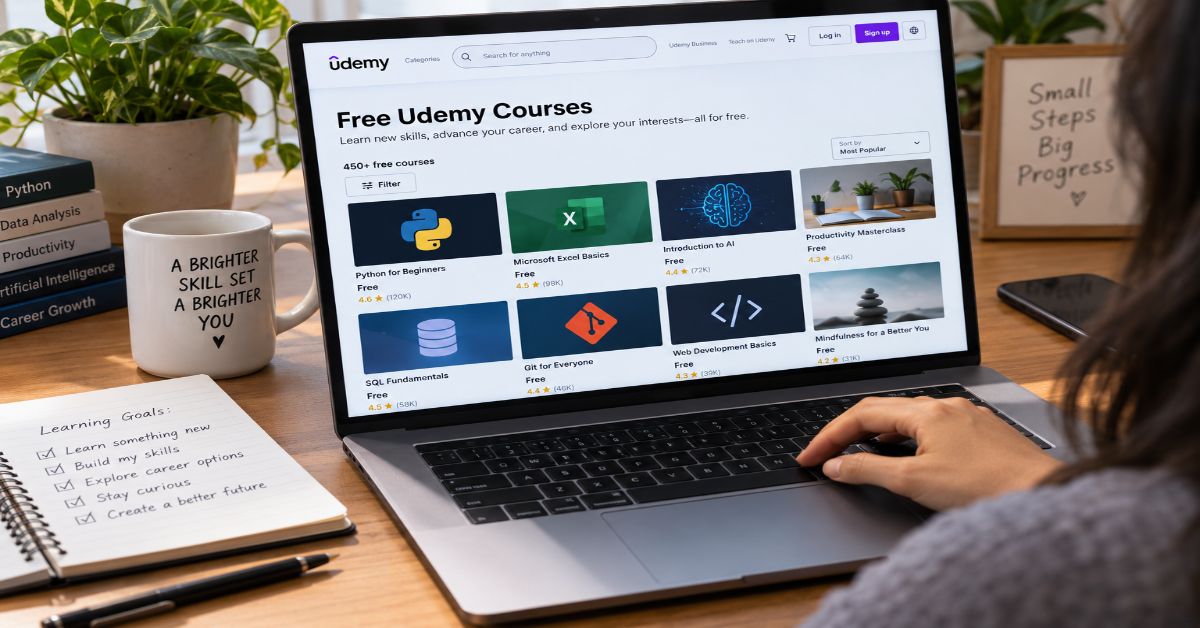
I checked Udemy’s official catalog and current support documentation before writing this guide, and the key fact is easy to miss: Udemy free courses are genuinely available, with the official free landing page currently promoting 450+ options, but ‘free’ can describe two different learning experiences. A course permanently priced at zero has a simplified feature set, while a normally paid course claimed through a 100% off instructor coupon keeps the paid-course experience. That difference matters more than another giant list of course links today.
For beginners, the permanent catalog is useful because it removes the payment decision. You can test Python, Excel, SQL, Git, productivity, AI concepts, and other subjects without committing money. The catch is scope. Udemy says free courses published after March 17, 2020 must be under two hours, and new free enrollments do not include a certificate, Q&A, or direct messaging. Free courses may also show ads.
That does not make them poor value. I would use them for a specific job: test a subject, learn a narrow skill, or build enough foundation to decide what deserves deeper study. I also found why ‘most popular’ is not always ‘best.’ In fast-moving fields such as generative AI, an old update date or obsolete curriculum vocabulary can matter more than a large student count.
This guide shows where to find legitimate free classes, how to distinguish permanent-free courses from temporary coupon deals, what you actually receive, and how to build a learning path that does not waste your time.
What Counts as a Free Udemy Course in 2026?
There are two practical ways to learn on Udemy without paying at enrollment. A permanently free course has no price set by the instructor and uses Udemy’s simplified free-course experience. A paid course redeemed with a 100% off instructor coupon remains a paid-course enrollment even though your checkout price is zero.
That distinction changes what you receive. Permanent-free courses sacrifice depth and support for easy access. Coupon-redeemed paid courses can preserve the longer curriculum, instructor interaction, and certificate attached to an eligible paid course. A normal sale-priced course is the third option when you already know the topic is worth investing in.
| Option | Price at enrollment | Certificate | Support features | Best use |
| Permanent free course | $0 | No for new enrollments | No Q&A or direct messaging | Sampling a topic or learning a narrow skill |
| Paid course with 100% off coupon | $0 while valid | Yes when the paid course is eligible | Paid-course feature set | Deeper study or certificate needs |
| Paid course on sale | Discounted | Yes when eligible | Paid-course feature set | Known priority skill with no coupon wait |
Where Can You Find Free Classes Safely?
I would start with Udemy itself. The official free-course page is the cleanest discovery point because it avoids expired codes and redirects. Udemy’s marketplace search also supports filters for level, language, ratings, duration, newest, subtitles, and other features.
- Open the official catalog or search for the skill you want.
- Confirm the Udemy course page itself shows free enrollment.
- Check the last-updated date before trusting the star rating.
- Scan the curriculum for the exact tools, versions, or concepts you need.
- Read recent reviews for broken resources, obsolete interfaces, or missing exercises.
- Enroll only if the final Udemy page still shows zero cost.
Coupon aggregators are useful as discovery feeds, not as the source of truth. A code can expire or hit a redemption limit before a third-party page is updated. If Udemy’s final page does not show zero, treat the deal as expired.
How I Judge Whether a Free Course Is Worth the Time
A free course still costs attention, so I use five checks. First, freshness: a 2023 productivity lesson may age well, while a 2023 AI tutorial can become obsolete quickly. Second, outcome: prefer a course that promises a testable skill, not vague mastery.
Third, match the promise to the duration. Because newer permanent-free courses are under two hours, narrow goals are more credible than ‘beginner to advanced’ claims. Fourth, use ratings as a signal, not a verdict. Recent reviews, sample lectures, and exercises matter more. Fifth, define the next step before enrolling: a project, deeper course, official documentation, or practice task.
| Check | Strong signal | Warning sign |
| Freshness | Recent update for fast-changing topic | Old UI, retired model names, obsolete APIs |
| Outcome | One clear skill or project | Broad mastery promised in under two hours |
| Practice | Exercises, files, or repeatable task | Video-only consumption with no application |
| Evidence | Recent reviews and useful preview | High rating but old or thin feedback |
| Next step | Project, documentation, or deeper path | No obvious use after completion |
What Do Current Free-Course Examples Reveal?
I reviewed a live sample on September 6, 2026. The snapshot below is not a permanent ranking because course status, ratings, counts, and update dates can change.
| Course example | Length | Last updated | Editorial read |
| Python (Free Course) – Part 1 | 1h 22m | June 2025 | Narrow beginner scope fits the format |
| Microsoft Excel Course for Beginners: Key Skills in 2 Hours | 1h 55m | February 2026 | Practical office-skill sampling |
| Basic Git and Github – essentials | 50m | February 2026 | Compact topic with stable fundamentals |
| Learn SQL / MySQL database basics FOR FREE | 1h 49m | December 2025 | Focused database introduction |
| ChatGPT Prompt Engineering (Free Course) | 57m | October 2023 | Popularity is high, but curriculum vocabulary needs freshness checks |
The strongest contrast is the ChatGPT course. Its page still showed curriculum references to GPT-3.5 and older OpenAI model terminology. I would treat the large learner count as historical popularity, not proof that every lesson reflects the 2026 tool landscape.
Which Udemy Free Courses Are Best for Beginners?
Programming fundamentals are a strong fit because a short course can teach one layer of the stack. Start with Python syntax, Git, SQL, HTML/CSS, or JavaScript, then build something small. If Python becomes your main path, Aperplexity’s robot trajectory retiming guide shows how basic programming can eventually connect to algorithms, constraints, and engineering systems.
Excel and productivity are equally suitable. A focused class can teach formulas, PivotTables, lookups, shortcuts, or data-cleaning habits quickly. After the basics, Aperplexity’s Excel VBA calculation guide shows how spreadsheet skills extend into automation and performance.
AI and web-development courses need a stronger freshness check. Favor recent material, maintained tools, and clear practice. Once beginner web concepts click, move toward version control, APIs, deployment, testing, and platform maintenance. Aperplexity’s ChromiumFX modernization guide illustrates the lifecycle thinking that basic tutorials often omit.
Creative and business subjects also work when the promise is narrow. Photography, presentation skills, marketing fundamentals, and productivity can benefit from short introductions. If creative work is a career goal, Aperplexity’s photography jobs guide explains why portfolio evidence and buyer needs matter more than collecting course completions.
What Do Free Courses Include and Leave Out?
The biggest limitation of permanently free courses is the feature gap. Udemy’s Free Course Experience says new free enrollments do not offer certificates of completion, Q&A, or direct messaging, and free courses may include advertisements before, during, or after lessons.
Lifetime access also needs precise wording. Udemy says learners retain marketplace access to free courses they enroll in, subject to its Terms of Use. Its lifetime-access policy also depends on continued account access and Udemy continuing to hold a license to the course. I read ‘lifetime’ as platform-policy access, not an unconditional guarantee that a specific course can never disappear.
Are 100% Off Coupons Better Than Permanently Free Courses?
A 100% off coupon is often the better option when it unlocks a normally paid course with deeper curriculum, exercises, Q&A, direct messaging, and an eligible completion certificate. Udemy states that paid courses enrolled in through promotional coupons retain paid-course features.
The trade-off is availability. Udemy’s current instructor coupon documentation lists a ‘Free: Open’ coupon as valid for up to 10 redemptions or five days, whichever comes first, and a ‘Free: Targeted’ coupon as valid for up to 100 redemptions or 31 days, whichever comes first. That is why deal pages can go stale quickly.
My rule is simple: use permanent-free classes for reliable introductions, and use coupon-redeemed paid courses only when the underlying course matches a real goal. Zero price is not a reason to fill your library with courses you will never start.
Can Udemy Free Courses Help You Get a Job?
Free classes can help with employability, but the enrollment itself is rarely the strongest evidence. A developer can turn lessons into a GitHub repository, Python automation, SQL analysis, or deployed page. An Excel learner can build a dashboard or automated workbook. A designer or photographer can create portfolio work.
I also separate a Udemy completion certificate from a professional certification. Udemy is not an accredited institution, and a certificate documents completion of an eligible paid course rather than independent professional licensure. If your goal is a stronger hiring signal, compare the learning path with Aperplexity’s career certification guide and pair any credential with visible project evidence.
What Risks and Trade-Offs Should You Check?
Watch five trade-offs. Stale instruction is the biggest in AI, cloud, software, advertising, and fast-changing tools. Shallow scope is structural because newer permanently free courses are short. Coupon friction is real because third-party pages can lag the current Udemy price.
Also avoid collection without completion. Free access makes it easy to save more courses than you can finish, so I would keep one primary course and one backup topic active. Finally, verify the credential type before enrolling. If a certificate matters, make sure the course is an eligible paid course obtained through a valid coupon or purchase.
The Future of Udemy Free Courses in 2027
The biggest platform change is already here. Coursera completed its combination with Udemy on May 11, 2026. The companies said the combined ecosystem reaches more than 290 million learners, 18,000 enterprise customers, and 95,000 content creators, while the two learning platforms remain separate for now. (Coursera, Inc., 2026; Udemy, 2026f)
Greg Hart, Coursera’s CEO, summarized the pressure behind the deal: ‘AI is transforming every job across every industry.’ The companies say they plan broader catalog access and more personalized, AI-powered learning experiences over time. Udemy’s current support notice says there are no immediate changes to pricing, existing content, accounts, or lifetime marketplace access.
For 2027, I expect discovery and personalization to matter more than raw catalog size. I would not assume the permanent-free tier will become longer or certificate-bearing, though. I found no official announcement promising those changes, so the current free-course rules remain the safer basis for planning.
Key Takeaways
- Permanent-free courses and 100% off paid-course coupons have different feature sets.
- New permanent-free enrollments do not include certificates, Q&A, or direct messaging, and ads may appear.
- New free courses published after March 17, 2020 must be under two hours, so focused outcomes are more realistic than broad mastery.
- Coupon-redeemed paid courses can offer better value when you need depth, instructor interaction, or a certificate.
- Update date matters most in fast-changing fields, especially AI, cloud, software, and digital marketing.
- Career value comes from projects, portfolio evidence, and role-specific credentials more than from collecting course enrollments.
- The Coursera-Udemy combination may change discovery in 2027, but no official policy currently removes the free-course limits.
Conclusion
I would not judge a free learning option by how many links a roundup can collect. The better question is whether one course gives you a clear, current, finishable step toward a real skill. Udemy’s permanent free catalog is strongest as a low-risk testing ground: learn the basics, sample an instructor, and decide whether a subject deserves deeper investment.
The caveat is deliberate. Permanent-free courses have fewer features, no new completion certificates, and short video limits for newer publications. If you need deeper curriculum or a certificate, a paid course redeemed with a valid 100% off coupon can be the better zero-cost outcome.
My preferred strategy is selective. Pick one recent course with a narrow learning goal and a practical next step. Finish it, build or practice something, then decide whether you need another free module, a coupon-backed paid course, or a more formal credential. That saves more time than collecting hundreds of enrollments you never use.
Frequently Asked Questions
Do Udemy free courses give certificates?
No. Udemy says permanently free courses do not offer certificates of completion for new enrollments. Learners who enrolled in certain free courses before March 17, 2020 may retain older certificate access. A normally paid course redeemed through a valid promotional coupon can still include its paid-course certificate when eligible.
Are free courses on Udemy really free?
Yes. Permanently free courses can be enrolled in without a course purchase price. Verify the final Udemy page because third-party coupon listings can expire. Free courses may include ads and have fewer features than paid courses.
How do I find free courses without coupons?
Use Udemy’s official free-course catalog or search a topic and apply available filters. Confirm the course is free on Udemy itself before enrolling rather than relying on an aggregator headline.
Do free courses have lifetime access?
Udemy says learners continue to have lifetime marketplace access to free courses they enroll in, subject to its Terms of Use. Its policy also depends on continued account access and Udemy continuing to hold a license to the course.
What is the difference between a free course and a 100% off coupon?
A permanently free course uses Udemy’s simplified experience. A normally paid course redeemed with a 100% off instructor coupon remains a paid-course enrollment with the associated paid features. Coupon availability is limited by time and redemption caps.
Which free courses are best for beginners?
Short, focused options in Python basics, Excel, SQL, Git, JavaScript, productivity, and introductory AI concepts are good starting points. Choose a recent update, a narrow outcome, and a clear practice step rather than the largest enrollment count.
Methodology
I researched this article on September 6, 2026 using Udemy’s official free-course catalog, learner support documentation, instructor coupon rules, lifetime-access policy, and the current Coursera-Udemy combination notice. I also reviewed live Udemy course pages across Python, Excel, Git, SQL, and prompt engineering to compare update dates, duration, enrollment scale, and curriculum language.
For SERP differentiation, I reviewed leading 2026 pages from Class Central, Course Coupon Club, Course Careers, SchoolMaker, and Guru99. The recurring pattern was list-first coverage, mixed definitions of ‘free,’ and inconsistent treatment of certificates, course length, or coupon mechanics. I used primary Udemy documentation where those points conflicted or needed clarification.
Course prices, ratings, student counts, update dates, and coupon availability can change after publication. I did not claim hands-on completion of the courses; first-person statements describe source review and editorial analysis. AI assistance was used in drafting and organizing this article. A human editor must review the content before publishing, verify claims and references against original sources, click every link, and confirm that first-person statements reflect the final editorial process.
References
Coursera, Inc. (2026, May 11). Coursera completes combination with Udemy to build the world’s most comprehensive skills platform.
Udemy. (2026a). Free online courses to achieve your goals.
Udemy. (2026b). The free course experience.
Udemy. (2026c). Free courses: What should instructors know?
Udemy. (2026d). Promote your course with coupons and referral links.
Udemy. (2026e). Lifetime access.
Udemy. (2026f). Coursera and Udemy combination.
Free Courses On Udemy. (2025). Python (Free Course) – Part 1 [Online course]. Udemy.
Kate, R. (2026). Microsoft Excel Course for Beginners: Key Skills in 2 Hours [Online course]. Udemy.
Stefan, C. (2026). Basic Git and Github – essentials [Online course]. Udemy.
Academia Programatorilor. (2025). Learn SQL / MySQL database basics FOR FREE [Online course]. Udemy.
Free Courses On Udemy. (2023). ChatGPT Prompt Engineering (Free Course) [Online course]. Udemy.
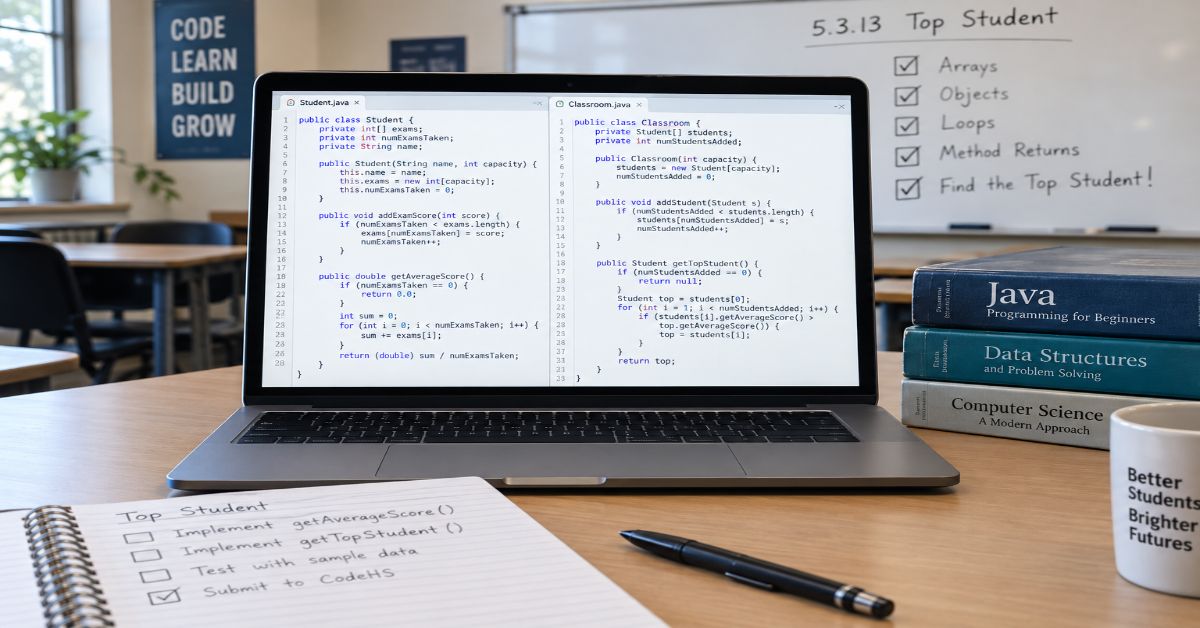
I treat 5.3.13 top student as a small exercise with a bigger lesson: the code is not really about finding a maximum, it is about keeping object state, array state, and numeric types consistent at the same time. The direct answer is that `Student.getAverageScore()` should average only the exams actually taken, and `Classroom.getTopStudent()` should scan only the students actually added, keeping the student whose average is highest.
That matches the current CodeHS Introduction to Java listing, where 5.3.13 Top Student appears inside the 5.3 “Using Arrays” lesson after Classroom Example, Exam Scores, Array References, and Find the Median. In other words, CodeHS places the exercise exactly where students are expected to combine arrays, object references, loops, and method return values. I also compiled and ran the core pattern locally with Java 21: scores of 88, 91, 93, and 90 produced 90.5; scores of 95, 92, 94, and 96 produced 94.25; and the classroom correctly returned the second student as the top student.
The confusing part is that two lengths exist at once. `students.length` is the array capacity, while `numStudentsAdded` is the logical number of usable entries. The same distinction exists in `Student`: `exams.length` is capacity, while `numExamsTaken` tells you how many scores belong in the average. Once I keep those pairs separate, the common null access, out-of-bounds, and integer-average bugs become much easier to diagnose. The sections below show a clean solution pattern, why it works, how ties behave, and how I would test it before submitting to an autograder.
What Does the Top Student Exercise Actually Ask You to Build?
The exercise uses two cooperating classes. `Student` owns one student’s exam data and average calculation. `Classroom` owns a collection of `Student` references and tracks how many are valid. The top-student method should ask each `Student` for its average rather than reimplementing exam logic.
| Element | Responsibility | Why it matters |
| Student.exams | Stores exam scores in a fixed-size int array | Unused positions may still contain default zero values. |
| Student.numExamsTaken | Tracks how many exam entries are valid | The average should stop here, not at the physical array length. |
| Student.getAverageScore() | Returns a double average for one student | The Classroom can compare students without knowing exam storage details. |
| Classroom.students | Stores Student object references | Unused positions are null until a student is added. |
| Classroom.numStudentsAdded | Tracks the logical number of students | The top-student loop must avoid unused null slots. |
| Classroom.getTopStudent() | Returns the Student with the highest average | The method should return an object reference, not only a score. |
Why returning a Student object matters
Returning the `Student` object preserves the winner’s identity. The caller can then access the name, grade level, GPA, or average. Returning only the maximum number would lose the connection to the student who produced it.
How Should getAverageScore() Work?
The average method has three jobs: handle the no-exam case, sum only valid scores, and force floating-point division. The last point is essential because Java integer division removes the fractional portion when both operands are integers. The Java Language Specification states that integer division rounds toward zero, so `362 / 4` is fine but `271 / 3` becomes `90`, not `90.333…`, unless one operand is converted to a floating-point type.
public double getAverageScore() {
if (numExamsTaken == 0) {
return 0.0;
}
int sum = 0;
for (int i = 0; i < numExamsTaken; i++) {
sum += exams[i];
}
return (double) sum / numExamsTaken;
}
I prefer the cast on `sum` because it makes the intention visible at the exact operation that needs it. Writing `sum / (double) numExamsTaken` also works. Declaring `sum` as `double` works too, but it is unnecessary when the stored exam scores are integers.
Why looping to numExamsTaken is safer than exams.length
Suppose the exam array has room for four scores but the student has taken only two. Iterating through all four positions includes two default zero values and lowers the average even though those zeros are not real exams. The counter is therefore not a convenience variable. It is the boundary of meaningful data.
How Do You Write getTopStudent() Correctly?
The simplest reliable pattern is to guard the empty classroom, seed the current winner with the first valid student, then compare the rest. Starting at index 1 avoids comparing the first student with itself.
public Student getTopStudent() {
if (numStudentsAdded == 0) {
return null;
}
Student top = students[0];
for (int i = 1; i < numStudentsAdded; i++) {
if (students[i].getAverageScore() > top.getAverageScore()) {
top = students[i];
}
}
return top;
}
The crucial boundary is `i < numStudentsAdded`. A classroom array can have room for ten students while only three have been added. Positions 3 through 9 are still `null`. Calling `getAverageScore()` on one of those unused references causes a `NullPointerException`, while using an index equal to the array size causes an array-bounds failure. Oracle’s ArrayIndexOutOfBoundsException documentation defines the exception as access using a negative index or an index greater than or equal to the array size.
A small optimization that improves the mental model
For this assignment, repeatedly calling `top.getAverageScore()` is readable because the exam array is tiny. In larger code, caching the current best average avoids recomputing it. Here, correctness and clear boundaries matter more than micro-optimization.
Why Do Index Errors and Wrong Averages Happen?
Most failures in this exercise come from mixing capacity with occupancy, or from letting Java choose integer arithmetic when a decimal result is expected. I use the following diagnostic table because each symptom points to a different state mistake.
| Symptom | Likely cause | Fix |
| IndexOutOfBoundsException | Loop condition allows i to reach array length, such as i <= students.length | Use i < the correct boundary. |
| NullPointerException in getTopStudent() | Loop scans unused Student slots | Loop only while i < numStudentsAdded. |
| Average is 87 instead of 87.5 | Both division operands are int | Cast sum or count to double before division. |
| Average is too low | Loop includes unused exam slots initialized to 0 | Sum only the first numExamsTaken entries. |
| Top student is wrong after adding students | numStudentsAdded was not incremented correctly | Increment once after a successful insertion. |
| Adding a fifth exam fails | Fixed exam array has reached capacity | Guard addExamScore with numExamsTaken < exams.length. |
This capacity-versus-occupancy distinction also appears in larger systems. Aperplexity’s
ETL process optimization guide makes the same broad engineering point at a different scale: process the data that is actually required instead of scanning or moving work simply because capacity exists. In this classroom exercise, `numStudentsAdded` and `numExamsTaken` are the compact version of that discipline.
How Should You Test the Classroom Before Submitting?
I tested the core logic with a small driver instead of relying on one happy-path case. A useful test should make the expected winner obvious, include a decimal average, and leave unused capacity in the classroom so the loop boundary is exercised.
public static void main(String[] args) {
Student maya = new Student(“Maya”, 10, 3.7);
maya.addExamScore(88);
maya.addExamScore(91);
maya.addExamScore(93);
maya.addExamScore(90);
Student leo = new Student(“Leo”, 10, 3.8);
leo.addExamScore(95);
leo.addExamScore(92);
leo.addExamScore(94);
leo.addExamScore(96);
Classroom room = new Classroom(5);
room.addStudent(maya);
room.addStudent(leo);
System.out.println(maya.getAverageScore()); // 90.5
System.out.println(leo.getAverageScore()); // 94.25
System.out.println(room.getTopStudent().getName()); // Leo
}
Your constructor signatures or getter names may differ from this driver, so match the starter code CodeHS gave you. The test logic is the important part: create known objects, add known scores, leave spare array capacity, then compare the printed result with a value you can calculate by hand.
| Test case | Expected behavior | What it validates |
| No students added | getTopStudent() returns null or the assignment’s required empty-case value | Empty collection guard |
| One student | That student is returned | Seed logic |
| Two different averages | Higher average student is returned | Core comparison |
| Average with .5 or .25 | Decimal is preserved | Floating-point division |
| Classroom has spare capacity | No null access occurs | Logical loop boundary |
| Two equal averages | Winner follows documented tie policy | Comparison operator semantics |
How Should Ties and Edge Cases Be Handled?
Ties are controlled by a single comparison operator. With `>` the first student who reaches the highest average remains the winner. With `>=` a later student with the same average replaces the earlier one. Neither rule is universally correct. The assignment specification or tests decide which policy is expected.
First-wins versus last-wins tie behavior
I would keep `>` unless CodeHS explicitly asks for a different tie rule because it is stable: once a top student is found, an equal score does not change the result. If a teacher wants all tied students, the method contract has to change, for example by returning a list rather than one `Student` reference.
What should happen when a student has no exams?
Returning `0.0` is a practical assignment-level choice because it prevents division by zero and gives the method a valid `double`. In a production gradebook, “no exams” is usually not the same state as “average of zero.” A richer design might return an optional value or apply an eligibility rule before ranking. That distinction is one of the hidden limitations of the classroom model.
What Does This Exercise Teach Beyond One CodeHS Grade?
I see three durable ideas here: counters define the valid part of a fixed array, objects should own the behavior closest to their data, and numeric types can change program results. Those ideas matter well beyond this assignment.
Aperplexity’s NCEdCloud login and access guide offers a useful systems analogy for students: authentication is one layer and the applications behind it are another. Here, the separation is smaller but similar. `Student` owns student-level state, and `Classroom` owns collection-level behavior.
The same habits scale into software engineering: define ownership, protect boundaries, and test empty, partial, and tied states. Explaining why a boundary is correct is stronger evidence than showing code that happened to pass. Aperplexity’s
guide to career-growth certifications makes a similar point from the career side: credentials are strongest when they are paired with projects that reveal real implementation decisions.
The Future of 5.3.13 Top Student in 2027
By 2027, the exact exercise number may matter less than the underlying lesson. CodeHS maintains multiple Java course versions, and its current AP Computer Science A course, Cortado, was redesigned for the College Board framework effective from fall 2025. Students should expect course organization and autograder details to change while the core Java ideas remain stable.
The durable concepts are arrays, object references, loops, class responsibility, and numeric types. A June 2026 CodeHS knowledge-base article by Jeremy Keeshin directs users to curriculum and product changelogs for current updates. In 2027, verify the starter code and method signatures before applying any solution pattern.
Aperplexity’s KracenSoft technology guide is useful for the same verification habit because it separates software discovery from primary-source confirmation when details can change. The rule is simple: use guides to understand the pattern, then check the platform’s current specification.
Aperplexity’s analysis of computing beyond smartphones also illustrates why foundational programming concepts outlast interface shifts. Devices and interaction models may change, but programs still need valid state, predictable types, controlled iteration, and clear object boundaries.
Key Takeaways
- `numExamsTaken` is the logical boundary for averaging; `exams.length` is only storage capacity.
- `numStudentsAdded` is the logical boundary for classroom traversal; scanning the full array can reach null entries.
- Casting before division is what preserves fractional averages such as 90.5 and 94.25.
- Seeding `top` with `students[0]` and looping from index 1 produces a simple, readable maximum-selection algorithm.
- The operator `>` creates a first-wins tie policy, while `>=` creates a last-wins policy.
- A no-exam result of 0.0 is convenient for the exercise but represents a simplified data model, not a universal gradebook rule.
- Test empty, one-student, decimal-average, spare-capacity, and tie cases before trusting an autograder result.
Conclusion
The value of this CodeHS exercise is that several beginner Java ideas meet in one place. A correct answer depends on more than a maximum comparison. The `Student` class must keep exam state consistent, the average method must respect the number of exams actually taken, Java must be pushed into floating-point division, and the `Classroom` must traverse only valid student references.
I would solve it by making each boundary explicit, then testing the smallest cases first. Empty, one-student, two-student, fractional-average, spare-capacity, and tie cases each expose a different assumption in the code.
Once those cases behave correctly, the solution stops feeling like a fragile assignment answer and starts looking like a small, well-defined object-oriented system. That is the result worth carrying forward: not one memorized method, but a repeatable way to reason about state, boundaries, types, and object responsibilities.
Frequently Asked Questions
What is the CodeHS 5.3.13 Top Student exercise?
It is an Introduction to Java exercise in CodeHS’s “Using Arrays” lesson. The current course listing places it after examples involving classrooms, exam scores, array references, and median-finding, so it combines array traversal with objects and method calls.
Why does getAverageScore return an integer in Java?
If both operands of `/` are integers, Java performs integer division and drops the fractional part. Cast either the sum or the number of exams to `double` before dividing, for example `(double) sum / numExamsTaken`.
Why does getTopStudent cause an IndexOutOfBoundsException?
The usual cause is a loop condition that allows the index to reach the array length, such as `i <= students.length`. Valid array indexes stop at `length – 1`, so the condition should use `<` with the correct logical boundary.
Why can getTopStudent cause a NullPointerException?
A `Student[]` can have unused slots that still contain `null`. If the method loops across the full capacity instead of stopping at `numStudentsAdded`, it may call `getAverageScore()` on a null reference.
How do I handle tied top students in CodeHS?
Using `>` keeps the first student with the highest average. Using `>=` lets a later tied student replace the earlier one. Follow the assignment’s expected rule, and document the behavior if you control the method contract.
Should getTopStudent return null for an empty classroom?
Returning `null` is a common defensive choice when the classroom contains no students, but the required behavior depends on the starter code and CodeHS autograder. Match the assignment specification if it defines a different empty-case result.
Methodology
I researched the exercise before drafting by checking the live CodeHS Introduction to Java course listing, CodeHS Java documentation, current CodeHS AP Computer Science A materials, Oracle Java documentation, and the Java Language Specification. I also verified five aperplexity.com internal-link targets as published live pages before placing them in the article. The exact exercise structure in this guide follows the supplied brief, while the course position, Java division behavior, array-bound behavior, and current CodeHS course direction were independently checked against primary sources.
For hands-on validation, I compiled a minimal Java test with unused classroom capacity. It produced averages of 90.5 and 94.25, returned the 94.25 student, and returned null for an empty classroom. Autograder acceptance can still depend on the supplied signatures, visibility, fields, and tie rule.
CodeHS can revise course versions, numbering, starter code, and autograder expectations. Also, a production gradebook may need to distinguish “no score yet” from a true zero average. I treat the `0.0` rule as assignment-appropriate, not universal.
AI assistance was used in drafting and organizing this article. A human editor must review the code, links, source citations, firsthand claims, and assignment-specific method signatures before publishing.
References
CodeHS. (n.d.). Introduction to Java (Latte): Points. Retrieved September 4, 2026, from CodeHS course points.
CodeHS. (n.d.). Documentation – Java. Retrieved September 4, 2026, from CodeHS Java documentation.
CodeHS Team. (2026, June 4). AP Computer Science A in Java. CodeHS Knowledge Base.
CodeHS. (2025, June 16). Tips for teaching the new CodeHS AP CSA Cortado course. CodeHS blog.
Keeshin, J. (2026, June 22). Following CodeHS blogs to learn about new updates. CodeHS Knowledge Base.
Oracle. (2025). ArrayIndexOutOfBoundsException (Java SE 25 & JDK 25). Oracle Java API documentation.
Oracle. (2026). The Java Language Specification, Java SE 26: Chapter 15, Expressions. Oracle Java Language Specification.
-

 Technology1 month ago
Hitomi la in 2026: Domain Status, Safety and Risks
-

 Technology1 month ago
ThomsonKids.com: Website Guide, Topics & Trust Check
-

 General1 month ago
Voozon.com: What It Is and How the Platform Works
-

 Business1 month ago
incabizgrowth.com Review: Content, Trust & Use
-

 Technology1 month ago
thesindi com Review: What TheSindi.com Really Offers
-

 Technology2 weeks ago
Scrolller in 2026: How It Works, Risks and Alternatives
-

 Business1 month ago
5starsstocks.com Review: Features, Trust and Safety
-

 Technology3 weeks ago
Web Development Best Practices: A 2026 Quality System