
General
Brand Name Normalization Rules for Clean Product Data

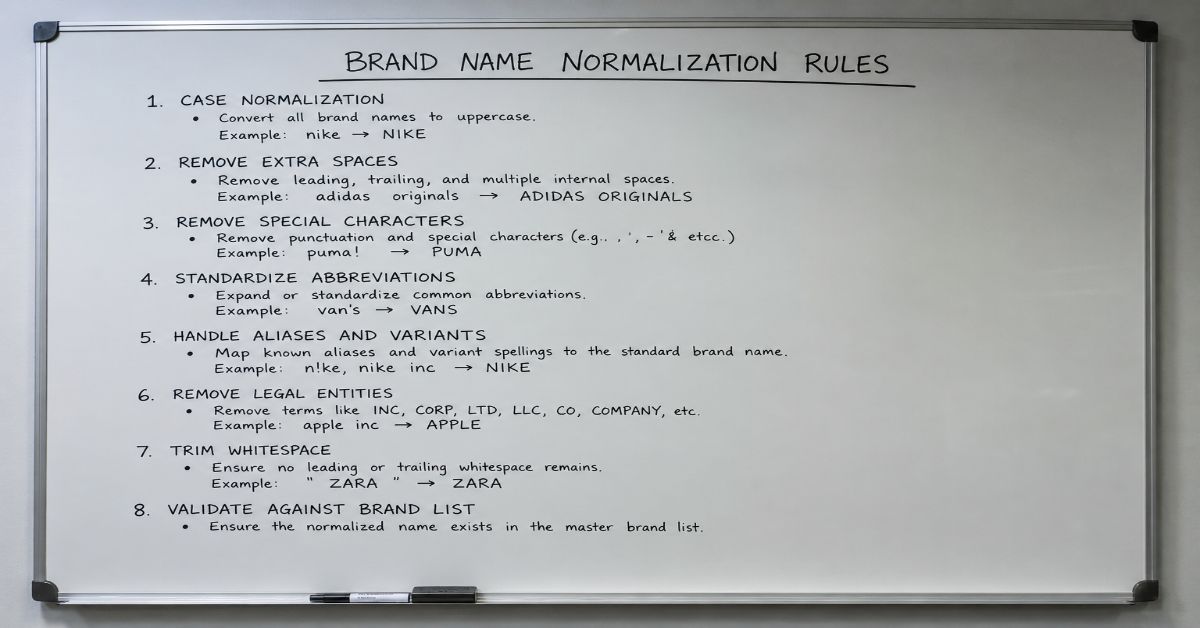
A catalog can contain 50,000 products and still fail on something as small as an ampersand. One supplier sends “H&M,” another sends “H & M,” a marketplace export lowercases it, and a matching script removes punctuation until several distinct labels collapse into the same bucket. I treat brand name normalization rules as identity controls, not cosmetic cleanup, because the real job is to make equivalent brand records match without rewriting the brand that customers actually recognize.
If you are searching for a reliable set of brand name normalization rules, the answer is to maintain two representations: a canonical display name that preserves the brand owner’s intended spelling and styling, and a normalized matching key used only for comparison, deduplication, search, and entity resolution. The matching key can safely standardize technical noise such as Unicode composition, surrounding whitespace, repeated spaces, and letter case. More aggressive changes, including punctuation removal, diacritic stripping, legal-suffix removal, token reordering, or parent-company substitution, need explicit rules because they can merge brands that are not actually the same entity.
This distinction matters across product information management, ecommerce feeds, master data management, CRM imports, marketplace integrations, and analytics. GS1 treats brand name as a consumer-recognized value determined by the brand owner, while Google Merchant Center expects the product’s recognized brand rather than placeholders such as “N/A” or “Generic.” Those requirements point in the same direction: normalization should improve consistency without inventing identity.
In this guide, I’ll show a field-level rule set, a canonical-brand dictionary model, a matching pipeline, examples of safe and unsafe transformations, and validation checks you can turn into SQL, Python, ETL, or PIM rules. The goal is a system that is deterministic, auditable, reversible, and conservative when evidence is weak.
Direct answer: The safest brand name normalization rules keep the official customer-facing brand intact and create a separate normalized key for matching. Standardize Unicode, whitespace, and case deterministically; treat punctuation, diacritics, legal suffixes, token order, sub-brands, and ownership changes as context-sensitive decisions rather than automatic deletions.
What are brand name normalization rules?
Brand name normalization rules are documented transformations and decision rules that map inconsistent source values to a stable brand identity. They should standardize format for matching while preserving an authoritative display value for publishing.
A strong normalization model separates four concepts that are often mixed together:
Source value: the brand string exactly as received from a supplier, seller, file, API, or user.
Canonical display name: the approved customer-facing form, such as “L’Oréal” or “H&M.”
Normalized match key: a machine-oriented representation used to compare candidate records.
Brand entity ID: a stable internal identifier that survives spelling corrections, aliases, and channel-specific formatting.
This four-part model gives you reversibility. You can always explain what arrived, what was published, how it was matched, and which entity ultimately owns the record.
Why should display names and matching keys stay separate?
The canonical display name and the match key solve different problems. One communicates identity to people; the other reduces irrelevant variation for machines. Combining them into one field forces a trade-off between brand fidelity and match performance.
| Layer | Example | Purpose |
| Raw source | H & M | Evidence exactly as received |
| Canonical display | H&M | Approved customer-facing form |
| Normalized key | h&m or a defined comparison variant | Deterministic matching |
| Brand entity ID | brand_004218 | Stable identity independent of text |
The separation also makes rule changes safer. If you later decide that apostrophes should remain significant for a certain category, you can regenerate match keys without rewriting the approved display value or losing supplier history.
Which brand name normalization rules should you apply?
The following rules work as a conservative baseline for product and organization data. Apply them in a fixed order so the same input always produces the same output.
1. Preserve the raw source before transforming anything
Store the original string and its provenance. Capture the source system, supplier or feed, ingestion timestamp, and source record ID when available. Never make the normalized value your only copy, because an incorrect merge is much harder to investigate without the original evidence.
2. Normalize Unicode before comparing brand names
Use a defined Unicode normalization form for the match key. NFC is a practical default when you want canonically equivalent sequences to compare consistently while retaining normal character distinctions. Unicode Standard Annex #15 explains that normalized strings give equivalent character sequences a stable binary representation. Avoid assuming that text that looks identical on screen is byte-for-byte identical.
3. Trim and collapse whitespace
Remove leading and trailing whitespace, convert repeated internal spaces to a single space, and standardize non-breaking spaces for matching. “Acme Labs” and “ Acme Labs ” should not create separate entities because of spacing alone. Preserve meaningful spacing in the display value if the official brand styling requires it.
4. Case-fold the match key, not the published brand
Make matching case-insensitive unless your domain has a documented exception. “LEGO,” “Lego,” and “lego” can share a lowercased or case-folded comparison key while the canonical display value retains the approved form. Do not title-case every brand automatically. That would damage names whose capitalization is part of their identity.
5. Treat punctuation as conditional, not disposable
Punctuation can be either noise or identity. Spaces around an ampersand may be irrelevant for matching, but replacing every “&” with “and” can create false equivalence. Hyphens, apostrophes, periods, plus signs, slashes, and symbols should be handled through brand-specific aliases or a carefully tested comparison layer rather than deleted from the master display value.
6. Keep diacritics in the canonical name
Accents and other diacritics belong in the approved display name when the brand uses them. A secondary accent-insensitive key may improve recall for search or candidate generation, but it should never overwrite the canonical form. For example, an accent-insensitive lookup might help connect a source that omitted the accent in “L’Oréal,” while the published value remains intact.
7. Remove legal suffixes only from organization match keys
Terms such as Ltd, LLC, Inc, GmbH, PLC, and S.A. describe legal entities, not necessarily consumer brands. They may be removable when matching company names, but do not strip them indiscriminately from brand strings. A brand can legitimately contain a term that resembles a suffix, and the product brand may differ from the legal manufacturer entirely.
8. Model sub-brands and parent companies explicitly
Do not normalize a sub-brand into its parent company simply because ownership is known. GS1 distinguishes Brand Name from Sub Brand Name, and it also notes that an endorsing or owning brand is not automatically the item’s primary brand. Store relationships such as parent_of, subbrand_of, or owned_by as separate attributes instead of rewriting one label into another.
9. Manage aliases, rebrands, and former names as data
A typo correction is different from a rebrand. Keep an alias table with alias type, effective dates when known, source, review status, and target brand ID. If a primary brand on a trade item actually changes, GS1’s GTIN Management Standard says that change can require a new GTIN. That makes historical identity and effective dating more than a naming preference.
10. Represent truly unbranded products as missing brand data
Do not convert empty brands into placeholders that look like real entities. Google Merchant Center specifically instructs merchants to leave the brand field empty for truly unbranded products rather than submitting values such as “N/A,” “Generic,” or “No brand.” Internally, use a null state plus a reason code if your data model needs to explain why the brand is absent.
Which transformations are safe, conditional, or dangerous?
A practical policy should classify transformations by risk instead of treating every cleanup rule as equally harmless.
| Transformation | Risk level | Recommended use |
| Trim outer whitespace | Low | Canonical cleanup and match key |
| Collapse repeated spaces | Low | Canonical cleanup when styling is not meaningful |
| Unicode NFC | Low | Canonical storage or match key |
| Case-folding | Low | Match key only |
| Accent removal | Medium | Secondary search or candidate key |
| Punctuation removal | Medium to high | Candidate generation with review |
| Legal-suffix removal | Medium | Organization matching, not generic product-brand cleanup |
| Token sorting | High | Avoid for final identity decisions |
| Parent-company substitution | High | Model as relationship, not normalization |
The principle is simple: use aggressive transformations to generate candidates, not to make final identity decisions. A fuzzy match can say “review these two values,” but it should not silently merge them when the business cost of a false positive is high.
How do you build a canonical brand dictionary?
A canonical brand dictionary turns normalization from scattered string functions into governed master data. Each row should represent one brand entity, not one spelling.
1. Assign a stable brand_id that is independent of the name text.
2. Choose one canonical_display_name based on the brand owner, product packaging, trusted supplier documentation, or another authoritative source.
3. Generate one or more match keys from that canonical name using a versioned normalization policy.
4. Attach aliases with an alias_type such as spelling_variant, spacing_variant, former_name, marketplace_variant, transliteration, or supplier_error.
5. Store parent brand, sub-brand, and legal owner relationships in separate fields or relationship tables.
6. Record evidence, reviewer, status, and effective dates for changes that affect identity.
7. Keep a do_not_merge list for confusingly similar names that repeatedly produce false positives.
A useful extra field is normalization_version. If version 3 changes punctuation handling, you can identify which records were processed under older logic and re-run only the affected population.
Brand Name Normalization Rules |
How should a brand matching pipeline work?
Brand matching should progress from deterministic evidence to weaker similarity signals. The system should stop as soon as it has a sufficiently reliable result.
| Stage | Evidence | Typical action |
| 1. Exact entity ID | Known brand_id | Accept |
| 2. Exact alias | Reviewed alias maps to one brand | Accept |
| 3. Deterministic key | NFC + whitespace + case rules | Accept if key is unique |
| 4. Product evidence | GTIN, MPN, supplier mapping, category context | Strengthen or disambiguate |
| 5. Fuzzy candidate | Edit distance or token similarity | Queue for scoring or review |
| 6. Ambiguous result | Multiple plausible brands | Do not auto-merge |
OpenRefine makes the same conceptual distinction in its clustering documentation: syntactic clustering is useful for spotting alternative representations, but it is not semantically aware. That is why a production pipeline should use string similarity as candidate generation and combine it with product identifiers, domain context, ownership data, or human review before a final merge.
What should the normalized match key contain?
A baseline key can be built by applying Unicode NFC, trimming, converting standardized whitespace, and case-folding. You may maintain additional keys for specific purposes, such as an accent-insensitive search key or a punctuation-light candidate key. Keep each key’s purpose explicit instead of packing every transformation into one irreversible “cleaned brand” field.
When should fuzzy matching be used?
Use fuzzy matching when deterministic keys fail but the record is still worth resolving. Short brand strings are especially risky because a one-character difference can represent a completely different entity. Require stronger corroborating evidence for short names, common words, or names that collide across categories and countries.
How do brand name normalization rules affect ecommerce feeds?
Ecommerce platforms make brand quality operational, not theoretical. A normalized internal dictionary should feed channel-specific values without violating each destination’s rules.
GS1 defines Brand Name as the name provided by the brand owner and intended to be recognized by the consumer. GS1 also treats Brand Name and Sub Brand Name as separate concepts.
Google Merchant Center’s product data specification uses a brand field with a maximum length of 70 characters and asks for the brand generally recognized by consumers. It warns against using your own store brand unless you manufacture the product or the item is legitimately private label or custom branded.
Google also treats brand as one of the unique product identifiers used alongside GTIN and MPN. Incorrect identifiers can reduce matching quality and may lead to disapprovals in relevant cases.
Schema.org’s brand property associates a Product or Service with a Brand or Organization. Keeping a stable internal brand entity makes it easier to emit consistent structured data across pages.
The practical rule is to normalize upstream, then render downstream. Your PIM or master data layer should hold the canonical identity, while each feed adapter applies only the formatting constraints that channel requires.
How do you test brand normalization before deploying it?
Test the rule set against a labeled sample before applying it to an entire catalog. The most important error is usually a false merge, because it can contaminate product grouping, search filters, attribution, analytics, and marketplace identifiers.
1. Build a gold set containing true matches, true non-matches, accented names, punctuation-heavy brands, sub-brands, short names, private labels, and known historical aliases.
2. Run every rule version against the same gold set so changes are comparable.
3. Measure precision for automatic merges and recall for candidate generation separately. Do not hide those two jobs behind one accuracy number.
4. Log the rule or evidence that produced each match. A reviewer should be able to see whether a decision came from an exact alias, a normalized key, a GTIN relationship, or fuzzy similarity.
5. Set a manual-review band for ambiguous cases and a hard no-merge threshold for weak evidence.
6. Sample accepted merges after deployment and track recurring false-positive patterns. Add those patterns to tests before changing the rule set again.
For automatic merges, optimize for precision first. Missing a match creates duplicate data that can still be reviewed later; merging two different brands can silently corrupt every downstream record that inherits the decision.
What mistakes cause the most false merges?
Most failures come from transformations that remove meaning faster than the pipeline adds evidence.
Deleting all punctuation and spaces, then treating the resulting string as authoritative.
Alphabetically sorting brand tokens, which can make distinct multi-word names collide.
Removing corporate suffixes from product brands instead of only from organization-resolution keys.
Replacing sub-brands with parent companies or manufacturers.
Assuming two similar strings are the same because they share a website domain, category, or country.
Using a fuzzy threshold that is constant for both three-character names and thirty-character names.
Overwriting raw values after a merge, which removes the evidence needed to reverse a bad decision.
Treating placeholders such as “unknown,” “generic,” and “N/A” as normal brand entities.
The antidote is not a more complicated string function. It is a data model that distinguishes formatting similarity from real-world identity.
Which standards should constrain your normalization policy?
A brand normalization policy should be locally useful but externally compatible. These references provide reliable boundaries for product and text data:
GS1 Global Data Model Attribute Implementation Guide: Use it to distinguish brand name, sub-brand, and other product attributes.
GS1 GTIN Management Standard: Primary brand: Use it when a true primary-brand change may affect product identity and GTIN assignment.
Google Merchant Center product data specification: Use it for feed-level brand requirements, length constraints, and unbranded-product handling.
Unicode Standard Annex #15: Use it to define the Unicode normalization stage of your technical matching key.
Schema.org brand property: Use it to keep on-page structured data aligned with your internal brand entity model.
Treat these as constraints, not as a universal deduplication algorithm. None of them gives you permission to collapse two real brands simply because their strings can be made similar.
Key takeaway
Good brand normalization does not make names look uniform. It makes identity decisions consistent. Preserve the brand owner’s canonical display name, generate separate deterministic match keys, model aliases and ownership relationships explicitly, and reserve aggressive similarity rules for candidate generation or review. When every merge is explainable and reversible, clean brand data becomes an asset instead of a hidden source of catalog risk.
Frequently asked questions about brand name normalization rules
Should brand names always be lowercase in a database?
No. Store the approved display name with its intended capitalization. Use a separate lowercase or case-folded key for case-insensitive matching and search.
Should I remove punctuation from brand names?
Not from the canonical display name. A punctuation-light key can help generate match candidates, but punctuation can be part of brand identity, so final merges should use stronger evidence.
How should I normalize brand names with accents?
Keep diacritics in the canonical value and normalize Unicode composition. If search recall requires it, create a secondary accent-insensitive key without replacing the official spelling.
Can I merge a sub-brand into its parent brand?
Not as a normalization step. Store the sub-brand and parent relationship separately so products can retain the brand identity shown to consumers while analytics can still roll up to the parent.
What should I do with N/A, Generic, or Unknown brand values?
Treat them as missing or low-quality source data, not as real brand entities. For channels such as Google Merchant Center, truly unbranded products should use an empty brand field rather than placeholder text.
How often should brand normalization rules be reviewed?
Review them whenever new source systems, markets, scripts, or recurring false matches appear, and version every material rule change. Re-run a fixed labeled test set before deployment so the impact is measurable.
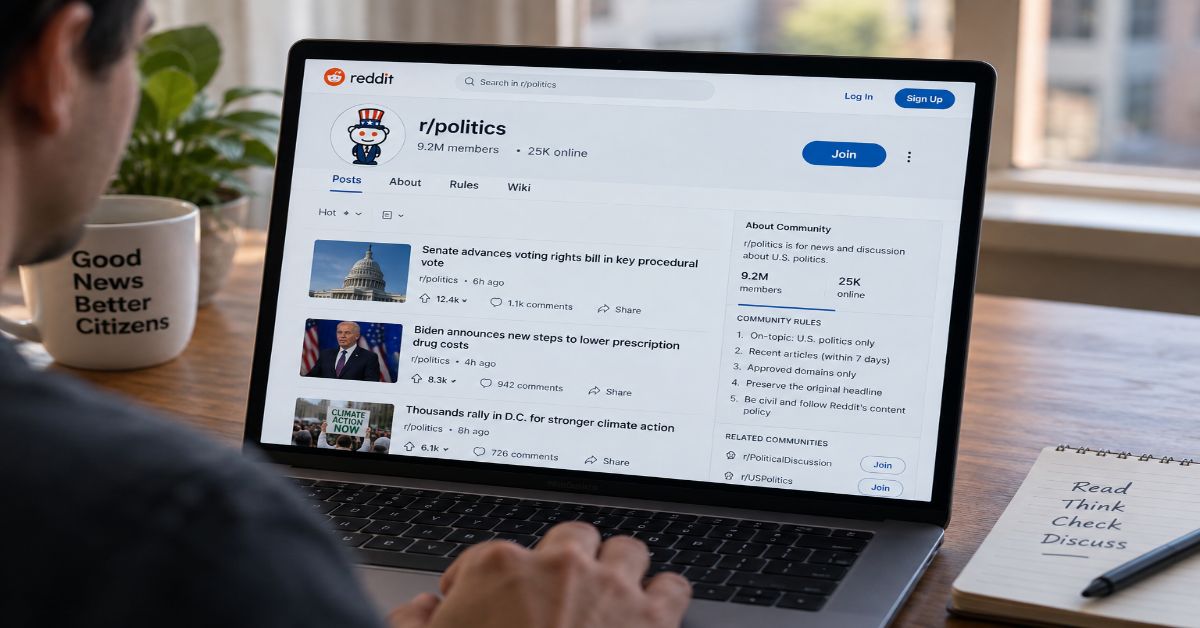
R Politics is Reddit’s large, fast-moving hub for current U.S. political news, but the feed is not a neutral index of everything that matters. I find it more useful to think of r/politics as a four-layer system: publishers create the reporting, subreddit rules decide what is eligible, Reddit’s voting and ranking decide what becomes visible, and commenters add interpretation after the fact. Each layer can add value, but none of them automatically verifies the others.
That distinction matters because the subreddit looks deceptively simple. A headline appears, thousands of people vote or comment, and a dominant interpretation can form before many readers open the linked article. The current rules narrow the feed to explicitly political U.S. content, generally require articles published within the last seven days, restrict submissions to approved domains, and require users to preserve the publisher’s headline with limited exceptions (Reddit, 2026a). Those rules improve topical discipline, yet they do not turn moderator approval into a fact-check or an upvote count into evidence.
The wider platform is also large enough that these mechanics matter. Reddit reported 130.3 million daily active uniques in the second quarter of 2026 (Reddit, Inc., 2026a). Third-party trackers put the politics community near 9.2 to 9.3 million members in 2026, although live counts vary by update time. I reviewed current rules, audience data, Reddit transparency material, recent academic research, and the present search landscape to answer a more useful question than “is this subreddit good or bad?” The better question is: what exactly does each signal on the page tell you, and what does it not tell you?
What Is r/politics, and What Is It Actually For?
The subreddit describes itself as a place for current and explicitly political U.S. news. Its topicality rules cover government policy, elections, political parties and candidates, politicians’ capacity to serve, advocacy, and newly reported facts tied to current U.S. politics. International events can qualify when the article substantially focuses on U.S. political implications.
That scope makes the community narrower than a general-news forum and broader than a partisan community. The unit of participation is usually a news link followed by a comment thread, so the article and the conversation sit next to each other even though they have different evidentiary value.
A practical way to read the page is to ask which layer you are looking at. The linked publication supplies the reported facts and sourcing. Moderators determine whether the submission fits community rules. Votes and engagement influence visibility. Comments supply reaction, arguments, corrections, jokes, and additional links. Confusing these layers is the fastest way to over-trust the feed.
Four layers of the r/politics information system.
| Layer | What it decides | What it does not prove | Best reader question |
| Publisher/source | What was reported, by whom, with which evidence | That the headline captures every nuance | What primary evidence or named sourcing supports the central claim? |
| Subreddit eligibility | Whether a post meets topicality, recency, domain, title, and format rules | That the story is factually correct or balanced | Why is this link allowed, and what relevant material is excluded by the rules? |
| Ranking and voting | Which eligible posts receive attention | That the most visible story is the most important or representative | Would I see a different picture in New, Top, or another source? |
| Comments | How participants interpret, challenge, or extend the story | That consensus in the thread reflects the U.S. public | Which comments provide checkable evidence rather than assertion? |
How Do the r/politics Rules Shape the Feed?
The rules do more than police behavior. They define the available news universe. Current guidance requires submissions to be directly tied to U.S. politics, published within the last seven days, and drawn from an approved-domain list. It also requires the publisher’s title to be copied with narrow exceptions such as removing “BREAKING” or all-caps styling (Reddit, 2026a).
I see three important consequences. First, the seven-day window creates a freshness bias. It helps prevent stale stories from recirculating as current, but it naturally favors breaking developments over long-horizon investigations, historical context, and retrospective analysis. Second, the approved-domain system reduces open submission chaos while concentrating attention inside a curated source pool. Third, the exact-title rule limits user-written sensationalism while moving the framing decision upstream to the publisher.
That last point is easy to miss. If a user cannot rewrite a headline, the headline may feel more objective. In reality, headline selection is still an editorial act by the original outlet. A copied headline can be accurate and still foreground one angle over another. I therefore read the title as a pointer to the article, not as a substitute for it.
Why moderation approval is not fact-checking
Reddit’s own transparency reporting shows how central community moderation is to the platform. In the second half of 2025, community moderators accounted for 52.7% of post and comment removals, while company admins accounted for 44.7% (Reddit, Inc., 2026b). Many moderator removals concern local rules such as topic, format, and duplication rather than truth or falsity.
That distinction is useful far beyond Reddit. In my guide to Critical Thinking Exercises: 12 Practical Drills, I use the same principle: repeated claims are not independent confirmations unless they trace to separate evidence.
Is r politics Biased or Politically Representative?
The most defensible answer is that the feed is not politically neutral, but a one-word ideological label is too crude to explain why. Selection begins with what users submit, continues through domain and topicality rules, and ends with community voting and ranking. That process can produce a strong visible consensus without establishing how a representative sample of Americans would respond.
Platform demographics add another caution. Pew Research Center reported in 2025 that 26% of U.S. adults used Reddit. In the same dataset, 32% of Democrats and Democratic-leaning independents said they used Reddit, compared with 22% of Republicans and Republican leaners (Pew Research Center, 2025). That is meaningful platform-level context, but it is not a direct measurement of the ideological composition of r/politics.
Recent academic work also argues for more precision. A 2026 study of political subreddits found low overlap among political communities and described polarization as the product of platform design, moderation, user agency, discourse, and broader political context. The authors also noted that academic research has not produced decisive empirical evidence establishing one simple political leaning for r/politics across time (Marwick et al., 2026).
So I would not use the subreddit as a proxy for the electorate. It can show what a large, self-selected Reddit audience is amplifying and arguing about. That is a real signal, but it is a signal of platform attention, not national public opinion.
Signals readers often misinterpret.
| Signal | What it can tell you | What it cannot tell you | Safer interpretation |
| High upvote score | The post resonated with users who encountered it | That the claim is true or nationally popular | Treat votes as attention, then verify the evidence |
| Many comments | The topic generated interest, conflict, or discussion | That it is objectively the day’s most important issue | Compare coverage across independent outlets |
| Approved domain | The source satisfies the community’s domain policy | That every article from the domain is equally strong | Evaluate the specific story and its sourcing |
| Exact headline | The submitter probably did not rewrite the title | That the publisher’s framing is neutral | Read beyond the title and compare framing |
| Moderator-approved post | The post survived community-rule enforcement | That moderators certified factual accuracy | Separate moderation from verification |
Why the Ranking System Matters More Than the Member Count
Large membership creates potential reach, but ranking controls practical visibility. In September 2026, current trackers place the community at roughly 9.2 to 9.3 million members. Those figures are useful as scale estimates, yet they do not tell you how many members are active, how many saw a particular post, or how many voted.
A 2026 academic study on political Reddit makes a related point: subreddit size is not a reliable measure of interaction, and participation is uneven over time. Another 2026 PLOS One study examining r/politics and other communities modeled whether posts received comments and how large discussions became using textual, semantic, temporal, domain, and author features. The broader lesson is straightforward: discussion size emerges from platform and content conditions, not merely from the intrinsic importance of the underlying event.
This is where the feed becomes editorial without having a conventional editor. Votes, timing, competition, duplicate rules, source familiarity, and the first wave of comments can all affect what rises. I call this ranking-as-editorial-proxy: no single editor chooses the front page, but the system still produces a hierarchy of attention.
How Should You Verify a Political Thread Before Believing or Sharing It?
I use a short source-first routine because it works even when the comment section is moving faster than the reporting. The goal is not to distrust everything. It is to identify which part of the claim can be checked outside Reddit and which part is interpretation.
1. Open the linked article and identify the central factual claim. Do not rely on the Reddit title alone.
2. Find the article’s evidence. Look for a court filing, bill text, vote record, transcript, dataset, named official, direct interview, or other primary material.
3. Check the publication and update time. Political stories can change after a vote, court order, correction, or new statement.
4. Compare at least one independent source when the claim is consequential, disputed, or based on anonymous sourcing.
5. Read comments for counterarguments and source leads, but promote a comment to evidence only when you can verify what it links or quotes.
6. Separate community sentiment from public opinion. Use representative polling when you want to know what Americans think.
This is the same date-and-source discipline I use in Aperplexity’s Minneapolis shooting verification guide, where a single broad search phrase can surface different incidents and outdated status information. The political version of that mistake is treating an early headline as the final state of a vote, court case, investigation, or negotiation.
For corporate and institutional claims, the logic is also similar to my Arab Media Group research workflow: a dated appointment or historical page proves what was true then, not automatically what is true now. Political reporting requires the same timestamp discipline.
A 60-second verification check.
| Question | Green flag | Caution flag |
| What is the source? | Named newsroom, official record, or attributable specialist | Screenshot, anonymous summary, or untraceable claim |
| How current is it? | Publication and update times match the developing event | Old story resurfacing without fresh context |
| What supports the claim? | Primary document, data, named source, or direct recording | Circular citation or article citing another summary |
| Is wording precise? | Claim matches what the source actually says | Headline turns possibility into certainty |
| Is there independent confirmation? | Separate source reaches the same core fact | Multiple outlets all trace back to one unverified origin |
What Are the Best Alternatives to r/politics?
The right alternative depends on the task. A fast news-link community is not automatically the best place for policy depth, international politics, or explicit ideological discussion. I would switch communities rather than force one feed to do every job.
| Community or source type | Best for | Main trade-off |
| r/politics | Fast U.S. political news discovery and large reaction threads | Ranking can make dominant viewpoints look more representative than they are |
| r/PoliticalDiscussion | Prompt-led policy discussion and slower argument | Less useful as a breaking-news wire |
| r/news | General U.S. news beyond politics-only scope | Political context may be less concentrated |
| r/worldnews | International reporting and non-U.S. events | U.S. domestic implications may receive less focus |
| Ideological subreddits | Understanding movement-specific arguments and priorities | Community norms are openly viewpoint-specific |
| Primary sources and established outlets | Verification, documents, and attributable reporting | Less immediate community reaction |
What Does the Wider News Shift Mean for Reddit Politics?
The context around Reddit is changing. The Reuters Institute’s Digital News Report 2026 found that social media and video networks were used for news by 54% of respondents across 48 markets, ahead of news organizations’ own websites and apps at 51%. Weekly use of AI chatbots for news reached 10% (Egan et al., 2026).
That makes source separation more important, not less. A reader may now encounter the same political claim through a Reddit headline, a creator video, an AI answer, a search snippet, and a publisher article in a single hour. Repetition can feel like corroboration even when every version traces back to one original report.
The useful skill is provenance: knowing where a claim began, what changed as it traveled, and which version contains the strongest evidence. My Threads app vs. Twitter comparison makes a similar point about real-time information: different platform mechanics change how quickly context can be found and how easily users can search beyond the first feed impression.
The Future of r/politics in 2027
I found no public 2027 roadmap for the subreddit, so any specific prediction about rule changes would be speculation. The stronger forecast comes from verified platform and news-consumption trends.
Reddit’s daily active uniques reached 130.3 million in Q2 2026, up 18% year over year, while the Reuters Institute documented a continued shift toward third-party news discovery. That combination means more people can encounter subreddit discussions through search, recommendations, shared links, and AI-mediated discovery without intentionally visiting the community first.
The likely pressure point is context. When a thread travels beyond its original subreddit, readers may see the headline or top comments without seeing the local rules that shaped eligibility. I therefore expect provenance cues, source transparency, and context preservation to become more valuable. Whether Reddit or volunteer moderators change specific features is uncertain.
A second pressure point is AI summarization. Generative systems can compress a long thread into a few sentences, but they may blur the difference between the linked article, moderator status, and user commentary. Publishers, platforms, and readers will benefit from making those layers easier to distinguish.
For the current submission requirements, I rely on the live r/politics rules wiki rather than older copied sidebars or archived summaries.
For platform-level audience context, the underlying percentages come from Pew Research Center’s 2025 social media report, which separates overall use by age, education, and party.
For the shift toward third-party news discovery, I used the Reuters Institute Digital News Report 2026 as the primary cross-market source.
Key Takeaways
- Treat the subreddit as a discovery and discussion system, not a neutral newsroom.
- Separate publisher evidence, moderation eligibility, ranking, and comments before judging a claim.
- Remember that a seven-day rule favors current reporting and can reduce the visibility of slower context pieces.
- Do not treat approved domains, exact headlines, moderator approval, or high vote totals as proof of factual accuracy.
- Use platform demographic data carefully: it can describe Reddit overall without proving the makeup of one subreddit.
- For consequential claims, open the source, find primary evidence, check timestamps, and compare independent reporting.
- Use other communities or primary sources when your goal is policy depth, international coverage, ideological perspective, or representative public opinion.
Conclusion
I think the most useful way to understand r/politics is to stop asking whether one feed can be perfectly neutral and start asking what each layer is designed to do. The subreddit is good at surfacing current U.S. political stories, concentrating discussion, and showing which narratives are resonating with a large group of Reddit users. Its rules also create more structure than an unrestricted social feed.
The limits are just as important. Eligibility rules narrow the source pool, recency rules favor the newest reporting, voting creates an attention hierarchy, and comments reflect a self-selected community rather than a representative electorate. None of those facts makes the subreddit useless. They simply define the conditions under which its signals should be interpreted.
For me, the best workflow is simple: use r politics to discover what people are discussing, then move outward. Open the reporting, inspect the evidence, check the timestamp, compare an independent source, and revisit fast-changing claims after new information arrives. That preserves the speed and perspective that make Reddit useful without asking the feed to carry more authority than it actually has.
Frequently Asked Questions
What is r politics on Reddit?
It usually refers to r/politics, a public subreddit focused on current and explicitly political U.S. news. Users mostly submit links from approved domains, then discuss the reporting in comment threads. The community is useful for discovering stories and reactions, but its ranking and comments should not be treated as a neutral news index or representative national polling.
What can you post on r/politics?
Current rules require content to be explicitly related to U.S. politics, generally published within the last seven days, and submitted from an approved domain. Titles usually need to match the publisher’s headline, with narrow formatting exceptions. The subreddit also restricts duplicates, solicitation, satire, user-generated text submissions, and several other content types.
Is r/politics left wing?
The visible feed often produces a strong ideological impression, but a precise answer needs more than anecdote. Pew shows Reddit overall is used more by Democrats and Democratic-leaning independents than by Republicans and Republican leaners. That is platform-level evidence, not a direct measurement of the subreddit. Recent academic work also cautions against reducing political Reddit to a single simple cause.
How many members does r/politics have in 2026?
Current third-party trackers place the community at roughly 9.2 to 9.3 million members. Live totals vary because trackers update at different times. Member count shows potential scale, not how many people saw, voted on, or commented in a particular thread.
Are r/politics approved domains trustworthy?
Approval means a domain meets the community’s source policy, not that every article is automatically accurate, complete, or politically neutral. Evaluate the specific story, its evidence, named sourcing, corrections, and whether independent sources confirm the central factual claim.
What is the difference between r/politics and r/PoliticalDiscussion?
r/politics is primarily a link-first current-news community. r/PoliticalDiscussion is better suited to prompt-led, substantive discussion about political questions and policy. If you want breaking stories, the first is usually faster; if you want slower argument and analysis, the second is often a better fit.
Methodology
I researched this article on September 12, 2026. I reviewed ten prominent current search results for the focus keyphrase and close variants, then compared their recurring coverage of rules, member counts, posting behavior, bias, and subreddit alternatives. Search order varies by location, device, personalization, and index freshness, so this is a competitive SERP sample rather than a permanent ranking list.
For factual validation, I prioritized the live r/politics rules wiki, Reddit’s Q2 2026 results and 2025 transparency report, Pew Research Center’s 2025 social-media data, the Reuters Institute Digital News Report 2026, and peer-reviewed 2026 research on political Reddit and discussion formation. Third-party trackers were used only for approximate subreddit-level membership because Reddit does not expose a stable public count in every interface.
Known limitations matter. Platform demographics do not prove the ideological composition of one subreddit. Upvotes and comments do not measure factual accuracy or representative public opinion. I did not access private moderation logs, deleted content archives, or individualized ranking data. Counterarguments about bias, censorship, and representativeness are therefore framed around verifiable rules and research rather than assumptions about moderator intent.
AI assistance was used to organize research and draft the article. A human editor should verify the final claims, APA references, internal links, and first-person statements before publishing.
References
Egan, J., et al. (2026). Digital News Report 2026: Overview and key findings. Reuters Institute for the Study of Journalism.
Marwick, A., et al. (2026). The entangled dynamics leading to the sedimentation of polarisation on political Reddit. Information, Communication & Society.
Pew Research Center. (2025, November 20). Americans’ social media use 2025.
Pew Research Center. (2025). Social media and news fact sheet.
Reddit. (2026a). The rules of r/Politics. r/politics Wiki.
Reddit, Inc. (2026a, July 30). Reddit reports second quarter 2026 results.
Reddit, Inc. (2026b). Transparency report: July to December 2025.
Schoch, D., et al. (2026). What gets Redditors talking? Predicting discussion initiation and size on Reddit. PLOS One, 21(5), e0344782.
GummySearch. (2026, September 5). r/politics subreddit stats and analysis.

A Word Counter gives you an instant total for the words in a piece of text, but the most useful version does more than display one number. I use the count as a control panel for length: words for assignments and articles, characters for forms and social posts, sentences and paragraphs for structure, and reading time for audience planning. The catch is that two reputable tools can disagree on the same text because “word” is not a perfectly universal software unit.
That difference matters when a teacher sets a 1,500-word ceiling, an application form rejects extra characters, or an editor expects a draft within a narrow range. Google Docs, Microsoft Word, browser tools, publishing systems, and programming libraries may treat hyphenated terms, URLs, numbers, apostrophes, footnotes, emojis, or non-Latin scripts differently. A total that is “close enough” for a blog draft may not be close enough for a scholarship application or legal filing.
Use a fast counter while drafting, but verify the final total in the system that controls the requirement. For web publishing, go one step further and ask whether the number actually serves the reader. Google’s current people-first guidance explicitly rejects the idea that Search has a preferred word count. Length can help you cover a topic, but extra words do not earn rankings by themselves.
This guide explains how counting works, why results differ, which metrics matter for different tasks, how reading time is estimated, what SEO writers should measure instead of chasing length, and how I would choose a reliable counting workflow in 2026.
What Does a Word Counter Actually Measure?
At its simplest, a counter identifies word boundaries and totals the units between them. Better tools also calculate characters, characters without spaces, sentences, paragraphs, lines, reading time, speaking time, and sometimes keyword frequency. The important point is that these metrics answer different questions. Word count tells you length in language units, while character count tells you whether text fits a platform or field limit.
A browser tool can feel exact because it returns an integer immediately, but the underlying rule set still matters. Some tools split on whitespace. Others use regular expressions. More sophisticated implementations can use Unicode-aware segmentation so that scripts without ordinary spaces are handled more intelligently.
| Metric | What it tells you | Best use |
| Words | Approximate linguistic length | Essays, articles, reports, manuscripts |
| Characters with spaces | Total typed length including whitespace | Forms, social posts, metadata limits |
| Characters without spaces | Text density without whitespace | Fields that define a no-space character rule |
| Sentences | Structural units ending in sentence boundaries | Pacing, readability, editing |
| Paragraphs | Block-level structure | Essay organization and scanability |
| Reading time | Estimated time to read at an assumed speed | Blogs, newsletters, scripts |
Why Do Word Counts Differ Between Tools?
The biggest information gap in many ranking pages is the assumption that there is one universal counting method. There is not. Unicode Standard Annex #29 defines default word-boundary behavior and also states that implementations may need tailoring for languages and ambiguous cases. It specifically notes that word boundaries are not limited to spaces and punctuation, and that scripts such as Chinese, Japanese, Thai, Myanmar, and Khmer need more specialized handling.
Hyphens, apostrophes, numbers, and URLs
Hyphenated compounds are a classic edge case. One counter may treat “state-of-the-art” as one word, while another may divide it. Apostrophes in contractions and possessives can also be handled differently. Numbers such as 2026 usually count as word-like units in many tools, while full URLs and email addresses may be treated as one token, several pieces, or special objects depending on the implementation.
Headers, footers, and footnotes
Google Docs provides a concrete example of scope differences. Its official help page says document-wide word count excludes headers, footers, and footnotes unless you select specific text. That means pasting the full visible document into a separate counter can produce a different number. I would use Google Docs’ built-in word-count instructions as the final authority when a submission is judged inside Docs.
| Text feature | Possible counting difference | Safer workflow |
| Hyphenated compound | One word or multiple words | Check the target editor with a sample phrase |
| Contraction | Usually one word, but rule sets vary | Use the same tool for drafting and final check |
| URL or email | Can be one unit or several segments | Avoid assuming browser and editor totals match |
| Footnote | May be excluded from document total | Verify in the required submission platform |
| CJK or Thai text | Whitespace splitting can fail | Prefer Unicode or language-aware segmentation |
| Emoji sequence | User-perceived character can span code points | Use a tool designed for Unicode-aware character counting |
How Accurate Should a Text Counter Be?
For ordinary English prose, reliable tools should agree closely because spaces and punctuation create obvious boundaries most of the time. The meaningful differences appear at edge cases. I would not accept a counter that hides its rules if the result affects a hard limit. A good tool should explain whether it counts numbers, hyphenated terms, quoted text, or special scripts, and it should distinguish characters with spaces from characters without spaces.
How Is Reading Time Calculated?
Reading time is normally an estimate: divide the number of words by an assumed reading speed. Marc Brysbaert’s meta-analysis of 190 studies involving 18,573 participants estimated adult English silent reading at 238 words per minute for nonfiction and 260 words per minute for fiction. The same review estimated reading aloud at 183 words per minute. Those figures are more defensible than the unexplained 200-WPM default that many tools copy from one another.
For a 1,190-word nonfiction article, 1,190 ÷ 238 gives about five minutes of silent reading. I treat that as planning guidance, not a promise. Difficulty, formatting, prior knowledge, and scanning behavior can move real reading time substantially. If you are preparing spoken copy for a social platform, Aperplexity’s Threads vs X comparison is also a reminder that publishing constraints differ by platform, so words and characters should be checked separately.
Does Word Count Help SEO?
Word count is useful for planning coverage, but it is not a target Google asks publishers to hit. Google Search Central’s current people-first guidance asks whether a publisher is writing to a particular word count because they heard Google has a preferred number, then answers: “No, we don’t.” Its ranking-systems documentation instead describes many systems and signals used to return relevant, useful results.
That changes how I use a word counter for SEO. I do not start with “How many words do I need to rank?” I start with “What does the searcher need to finish the task?” Then I use length as a diagnostic. If the draft is 600 words and the query requires a comparison, edge cases, examples, and FAQs, the low count may reveal missing coverage. If the draft is 3,000 words but repeats the same point, the high count reveals waste rather than authority.
A second diagnostic is originality and editorial ownership. Aperplexity’s AI text detector guide reaches the same SEO conclusion from a different angle: content teams should prioritize useful, original, verifiable material rather than chasing a detector score. Counting and detection are both measurements, not substitutes for quality.
What should SEO writers measure instead?
- Intent coverage: does the page answer the primary task and the important follow-up questions?
- Entity clarity: are terms, tools, platforms, and rules defined precisely?
- Information gain: does the page add a comparison, calculation, workflow, limitation, or source-backed insight missing from competing pages?
- Source quality: are current claims tied to primary or authoritative documentation?
- Internal linking: can readers move naturally to related material without irrelevant anchor stuffing?
- Readability: are paragraphs, lists, tables, and headings easy to scan on mobile?
When I audit a page through Google, I also separate ranking questions from search-operator behavior. Aperplexity’s defensive guide to Google search operators makes that distinction clearly: an operator can reveal indexed material, but it is not a complete measurement of Google’s index or ranking logic.
Which Word and Character Metrics Matter for Different Tasks?
The right metric depends on the constraint. Academic instructions usually specify words. Social networks and form fields often specify characters. Email subject lines, page titles, and metadata are frequently evaluated by visible length rather than a universal word target. A script may care about speaking time. A manuscript may care about total words and chapter balance.
| Task | Primary metric | Secondary metric | Best final check |
| Essay or assignment | Words | Paragraphs / citations | Institution or LMS rule |
| Job or scholarship form | Characters or words | Spaces included? | The actual application field |
| Blog article | Intent coverage | Words / reading time | CMS preview and editorial brief |
| Social post | Characters | Words / links | Platform composer |
| Speech or video script | Speaking time | Words / sentences | Read-through at natural pace |
| Book manuscript | Words | Chapters / pages | Publisher or editor requirements |
A Reliable Counting Workflow I Recommend
I prefer a two-check workflow because it is fast enough for everyday writing and robust enough for strict limits. The first tool helps during composition. The second is the environment that will actually accept, publish, or grade the text.
- Draft in your normal editor and keep a live word and character count visible if available.
- Before finalizing, identify the controlling rule: words, characters, characters without spaces, pages, or speaking time.
- Clean accidental duplicate spaces, pasted formatting, and hidden text that could affect a transfer between systems.
- Check the text in a browser counter to catch obvious length problems quickly.
- Paste or open the final version in the platform that enforces the limit and record that total as the submission count.
- If the two totals differ, test edge cases such as hyphens, footnotes, URLs, and non-Latin text rather than assuming one tool is broken.
For sites that publish their own counting tool, discoverability matters too. A utility should be easy to reach from navigation without turning the page into a directory. Aperplexity’s Quick Links guide offers a useful UX principle here: shortcuts work best when they remove searching instead of creating another layer of clutter.
Risks and Trade-Offs Most Text Counters Miss
A precise number can still answer the wrong question
A 2,000-word article can be thin if it repeats itself, while a 900-word page can be complete for a narrow query. The risk is measurement substitution: because count is easy to see, writers optimize it instead of the requirement that actually matters.
Keyword density can encourage bad editing
Many counters surface top words or keyword percentages. That is useful for spotting accidental repetition, but I would not treat a density percentage as an SEO target. Search systems evaluate relevance and quality through far richer signals than one repeated phrase.
Multilingual text needs better segmentation
Whitespace-based counting is convenient for English and many European-language texts, yet it becomes unreliable for languages where spaces do not consistently mark word boundaries. Unicode’s current segmentation standard explicitly describes the need for tailoring in several writing systems. A tool that claims universal language accuracy should explain how it handles those scripts.
Character count is not always the same as what a person sees
Unicode can encode what a reader perceives as one character using multiple code points. Emoji sequences are a familiar example. For ordinary form limits, the platform’s own counter should therefore be the final judge because the platform defines what it accepts.
The Future of Word Counting in 2027
The most credible direction for 2027 is not a more decorative counter. It is more transparent, language-aware measurement. Unicode 18.0, published in September 2026, continues to formalize segmentation rules and allows tailored implementations where defaults are insufficient. That gives tool developers a stronger basis for multilingual counting than simple whitespace splitting.
I also expect counters to become more context-aware without needing to become generative writing assistants. Useful additions include selectable counting rules, clearer document-scope explanations, local-only processing, accessibility-friendly interfaces, import support, and side-by-side totals for different editor conventions. The uncertain part is standardization: there is no evidence that all major editors will adopt one identical definition of a word, so cross-tool differences will remain an issue worth exposing rather than hiding.
Key Takeaways
- Use the final submission or publishing platform as the authority when a hard limit matters.
- Expect small differences across tools because hyphens, URLs, footnotes, punctuation, and Unicode boundaries are handled differently.
- Use 238 WPM as a research-backed planning estimate for adult English nonfiction reading time, not as a promise for every audience.
- Treat character count and word count as different measurements with different use cases.
- Do not chase article length for Google: current Search Central guidance says Google has no preferred word count.
- For multilingual text, favor counters that explain Unicode or language-aware segmentation rather than claiming universal accuracy without methodology.
Conclusion
A counting tool is most valuable when it helps you make a decision, not when it simply produces a number. I use it to keep a draft inside a requirement, compare versions, estimate reading time, catch bloated sections, and decide whether a platform’s character limit will be a problem. For strict work, though, the final authority should always be the system that will receive the text.
The deeper lesson is that counting is a rules problem. Hyphens, footnotes, URLs, scripts without ordinary spaces, and Unicode character sequences can change what software sees as a word or character. That is why transparent rules matter more than a claim of perfect accuracy.
For SEO, the same discipline applies. Measure length, but do not confuse length with usefulness. Google explicitly says it does not have a preferred word count. A strong page earns its space by answering the query completely, adding verifiable information, and helping the reader finish the task without searching again. The best counter supports that work quietly, accurately, and without becoming the goal itself.
Frequently Asked Questions
What is the most accurate word-count tool?
The most accurate option is the one whose rules match the platform judging your text. For a Google Docs submission, use Google Docs as the final authority. For a web form, trust the form’s own counter. A browser tool is excellent for drafting and second checks, especially when it explains how it treats hyphens, numbers, spaces, and multilingual text.
Why does my word count differ between Google Docs and an online counter?
Google Docs excludes headers, footers, and footnotes from its whole-document count. Online tools may also use different rules for hyphens, URLs, punctuation, and non-Latin scripts. Compare a small sample containing those edge cases to find the source of the mismatch.
Does a text counter include numbers?
Many counters treat standalone numbers such as 2026 as word-like units, but the rule is not universal. If numbers materially affect a hard limit, test the exact submission platform rather than assuming every counter follows the same convention.
What is the difference between a word count and a character count?
Word count estimates text length by linguistic units. Character count measures typed symbols and usually includes letters, numbers, punctuation, and sometimes spaces. Forms and social platforms often enforce character limits, while essays and manuscripts more commonly use word limits.
How many words per minute should a reading-time calculator use?
For English nonfiction, 238 words per minute is a strong research-backed default from Marc Brysbaert’s meta-analysis. Actual speed varies by difficulty, formatting, reader skill, and whether the person is reading closely or scanning.
Is 2,000 words better for SEO than 1,000 words?
Not automatically. Google says it has no preferred word count. A 2,000-word page is useful only when the extra space adds relevant answers, evidence, comparisons, examples, or clarity. Padding a page to reach a number can make it less useful.
Can an online counter handle Urdu, Chinese, or other non-English text?
It can, but quality depends on segmentation. Unicode notes that some scripts require tailored word-boundary handling and that whitespace is not a universal word separator. For multilingual work, choose a tool that documents language-aware or Unicode-aware counting rules.
Methodology
I researched this article on September 11, 2026. I reviewed current high-visibility results for “word counter” and close variants, including WordCounter.net, Grammarly, W3Schools, PrePostSEO, WordCount.Online, WordCounter.pk, Counter-Word, WordCount.com, TinyWordCount, and word-counter.dev. Search order varies by location, personalization, and time, so this is a competitive sample rather than a permanent ranking list.
The recurring SERP pattern was feature similarity: most pages emphasize instant counts, characters, sentences, paragraphs, reading time, keyword density, privacy, or file upload. I built the article around less consistently covered questions: editor-to-editor discrepancies, Unicode segmentation, document scope, a research-backed reading-speed benchmark, the difference between word count and SEO quality, and a two-check workflow for hard limits.
Validation prioritized Google Docs Help for document counting behavior, Google Search Central for SEO guidance, Unicode Standard Annex #29 for text segmentation, and Marc Brysbaert’s reading-speed meta-analysis. I verified each Aperplexity internal destination through live search before inserting it. I did not run a controlled benchmark across every counter, so I do not claim that one third-party tool is universally the most accurate.
AI assistance was used in research organization and drafting. A human editor must review the article before publishing, manually verify named claims and APA references against the original sources, confirm every link remains live, and ensure all first-person statements accurately reflect the editor’s real process.
References
Brysbaert, M. (2019). How many words do we read per minute? A review and meta-analysis of reading rate. Journal of Memory and Language, 109, 104047. Source
Google. (2026). Creating helpful, reliable, people-first content. Google Search Central.
Google. (2026). A guide to Google Search ranking systems. Google Search Central.
Google. (n.d.). Count the words in a document. Google Docs Editors Help. Retrieved September 11, 2026.
Unicode Consortium. (2026, September 1). Unicode Standard Annex #29: Unicode Text Segmentation, Revision 49. Source

Adjacent means next to, very near, or sharing a boundary, but that simple answer hides the reason people keep searching the word: the relationship changes with context. I see the confusion most clearly when the same term moves from a hotel room to a right triangle, then into a property description or a security discussion. In one setting, two things can be close without touching. In another, a shared side, vertex, edge, or permission path is the whole point.
That makes this a useful example of a word whose core idea stays stable while its test changes. In ordinary English, I ask whether two things are beside or near each other. In geometry, I ask what they share. In trigonometry, I first choose the acute angle because the “next-to” leg is relative to that angle. In property language, I slow down because a deed, statute, planning rule, or court can give near-synonyms different legal consequences. In modern category-nearness compounds, physical space disappears and the word signals similarity or association instead.
Most high-ranking pages handle one or two of those jobs well. Dictionary pages are excellent at concise definitions and synonyms. Math pages explain angles and sides. What they rarely do is give one decision framework that prevents a reader from carrying the wrong sense into a different field. That is the gap I am closing here. I will define the term once, compare it with adjoining and contiguous, work through a right-triangle example, show the property-law caution, explain the newer compound use, and separate an emerging security phrase from established identity concepts. The result is a reference you can use for a test question, sentence, contract review, or technical discussion without guessing.
What Does the Word Mean?
The core definition is “next to or very close to something.” Depending on the field, it can also mean sharing a border, side, vertex, edge, or another directly relevant relationship. The most useful shortcut is not memorizing separate definitions. It is identifying what kind of nearness the field cares about.
I use a six-part “adjacency ladder” to make that decision quickly:
- Physical nearness: Are the things beside or very close to each other?
- Boundary contact: Do they share a wall, line, side, corner, edge, or other boundary?
- Angle-relative position: In a triangle, which side lies beside the chosen angle without being the hypotenuse?
- Legal relationship: Does the governing document or jurisdiction define proximity, touching, or a common boundary in a specific way?
- Category nearness: Is a hyphenated relationship label being used to mean related to a category without being fully inside it?
- Access relationship: In technical security language, does an application weakness lead into an identity, token, permission, or service-account control surface?
The table below shows why a single one-line definition is not enough for every search intent.
| Context | What the relationship means | Must there be direct contact? | Quick example |
| Everyday English | Near, beside, or next in position | No | Two rooms on the same corridor |
| Geometry | Shares a relevant side, vertex, or edge | Usually yes, by definition | Two angles share a vertex and one side |
| Right-triangle trig | The leg beside the chosen acute angle | Yes, it meets that angle | The leg used in cosine |
| Property / law | Near, bordering, or otherwise defined by the instrument | Depends on wording and jurisdiction | A parcel beside another parcel or across a road |
| Graph theory | Two vertices joined by an edge | Direct graph connection | Nodes u and v share an edge |
| Modern category compound | Related or similar, but not exactly in the category | No physical contact involved | A career close to science |
| Security coinage | Application weakness reaches identity controls | Conceptual path, not physical contact | App flaw exposes a token or delegated permission |
For readers who like context-first word guides, I use the same source-and-usage discipline in Mazel and Mazel Tov: Meaning, Usage and Pronunciation, where literal translation alone does not tell you the correct social use.
Adjacent vs Adjoining, Contiguous, Neighboring and Abutting
These words overlap, but they are not perfect substitutes. In ordinary editing, I treat them as a scale from broad nearness toward stronger physical contact. Legal writing is the exception: the controlling statute, deed, regulation, or case can override a tidy dictionary distinction.
| Term | Practical default meaning | Touching implied? | Best caution |
| Focus word | Next to or very near | Not always | Do not assume a shared boundary without context |
| Adjoining | Next to and commonly joined or touching | Often | Courts may read it more broadly in a specific rule |
| Contiguous | Connected or touching along a point or boundary | Usually | Some property rules treat land divided by a road or right-of-way as contiguous |
| Neighboring | Nearby in the same area | No | Distance can be broader and less precise |
| Abutting | Directly borders | Yes | Use when common boundary contact is the point |
Why property and legal wording needs context
Cornell’s Legal Information Institute explains that contiguous land ordinarily means touching or sharing a common corner or boundary, while also noting that land in common ownership can remain contiguous even when a road or right-of-way divides it. Cornell’s Wex definition of contiguous is a useful reminder that legal vocabulary can carry rule-specific exceptions.
A 2023 English Court of Appeal decision shows another reason not to turn the dictionary distinction into a universal legal rule. In CAB Housing Ltd v Secretary of State [2023] EWCA Civ 194, the court accepted that “adjoining” could extend beyond the narrow sense of physical touching in the planning context before it. My practical rule is simple: for a contract, zoning issue, deed, easement, or dispute, read the defined terms and local authority before relying on everyday usage.
That same context discipline matters when a search term may not even be an ordinary dictionary word. My Misned meaning and spelling guide shows why source identity can matter more than forcing a neat lexical definition.
How Does the Term Work in Math?
Math makes the idea more exact. Two angles are neighbors when they share a vertex and one side without overlapping interiors. Two sides of a polygon are neighbors when they meet at a vertex. In a right triangle, however, the label depends on the acute angle you choose.
Which side is next to the angle in a right triangle?
First find the hypotenuse, the side opposite the 90-degree angle. It never changes. Then choose one acute angle. Of the two sides that touch that angle, ignore the hypotenuse. The remaining leg is the side used as the “next-to” side for that angle. The other leg is opposite.
/|
/ | opposite
hyp. / |
/θ__|
next-to leg
OpenStax gives the standard ratios as cosine = next-to leg / hypotenuse and tangent = opposite / next-to leg. See OpenStax right-triangle trigonometry. A small numeric example makes the label concrete: if a right triangle has a hypotenuse of 10 and the leg beside angle θ is 8, then cos(θ) = 8/10 = 0.8. If the opposite leg is 6, tan(θ) = 6/8 = 0.75.
The hidden test-prep trap is angle switching. If you move from one acute angle to the other, the two legs swap roles: the side that was beside the first angle becomes opposite the second. The hypotenuse remains the same. That single observation prevents many SOHCAHTOA mistakes.
If your math work happens inside spreadsheets or VBA rather than a geometry exercise, my Application.Calculate in Excel VBA guide is a separate reference for how Excel recalculates dependent formulas and workbooks.
What does the idea mean in graph theory?
Graph theory uses the same “direct relationship” idea in another form. Two vertices are neighbors when an edge directly connects them. Two edges can also be neighbors when they meet at a common vertex. This is stricter than ordinary physical nearness because the graph relationship is defined by connection, not by how close two points happen to look on a drawing.
How Is the Word Used in Property and Real Estate?
In a listing, survey conversation, planning notice, or deed, the word usually signals that one parcel, structure, or feature lies next to or near another. The mistake is treating that ordinary meaning as proof of a shared legal boundary. A house across a narrow road may be described conversationally as nearby or next to another house, while an abutting parcel is much more specific about boundary contact.
A practical boundary example
Imagine Lot A, a 20-foot public lane, and Lot B. In everyday speech, a seller may describe Lot B as the nearby property. If a contract says the lots must “abut,” the lane matters because direct border contact is missing. If a local rule defines “contiguous” to include parcels separated by a right-of-way, the answer can change again. The controlling text matters more than the conversational label.
For buyers, owners, and editors, I would check four things before making a legal inference: the survey or parcel map, the deed description, any defined terms in the governing document, and the jurisdiction’s cases or statutes. This is not a technicality. Easements, setbacks, notices, access rights, and development rules can depend on the exact relationship between parcels.
What Does “-Adjacent” Mean in Modern English?
Modern English has extended the word beyond physical space. Cambridge now records the compound form as a way to describe something that is not exactly in a category but is very similar or closely related to it. Current Collins material also recognizes postpositive category-nearness uses. The semantic move is easy to see: the relationship is no longer “beside this building,” but “beside this category.”
That newer sense is useful when the boundary between categories is fuzzy, but it can also become evasive. Calling work “close to finance” may tell a reader that a role touches financial systems without saying whether it is accounting, banking, analytics, compliance, or software. I use the construction when similarity is the point, then define the actual relationship in the next sentence.
A simple test for category-nearness
- Use the compound when something is meaningfully related to a category but does not fully belong to it.
- Avoid it when a more exact label is available and the distinction affects responsibility, expertise, or risk.
- In formal documents, define the category instead of relying on a fashionable compound that different readers may interpret differently.
What Is an Identity-Adjacent Exploit Path?
A 2026 security glossary uses this identity-related exploit-path label for an application weakness that becomes more serious because it reaches credentials, tokens, service accounts, delegated permissions, session artifacts, or cloud roles. The concept is plausible and useful, but the label itself needs caution: I found the phrase in a recent NHI Mgmt Group glossary, not as a broadly standardized term in Microsoft, NIST, CISA, OWASP, or MITRE documentation.
What established identity concepts sit behind the phrase?
Microsoft documents the underlying objects clearly. An application can have a service principal that represents its identity in a tenant, and that principal can receive permissions to resources. The Microsoft Learn application and service principal documentation explains that service principals define what an application can do and what resources it can access.
That creates a real attack-chain question even if you never use the newer label. If an application flaw exposes a refresh token, lets an attacker alter OAuth consent, steals a workload credential, or reaches a privileged service principal, the risk has crossed from code behavior into identity authorization. The useful security insight is the path, not the buzzword.
A practical scenario
Suppose a workflow service accepts untrusted input and can be manipulated into reading a secret that contains an API credential. The initial bug is application-side. If the stolen credential belongs to a service principal with broad permissions, the impact is now governed by identity scope. Investigation should therefore include the application logs, secret exposure, token issuance, service-principal permissions, sign-in history, and any actions performed with that identity.
For Microsoft-focused identity administration, see my Entra Admin Center identity and access guide. For the operational side of detecting and investigating token or identity abuse, the SOC operations guide covers telemetry, investigation, and response design.
Synonyms, Collocations and Example Sentences
The best synonym depends on whether you mean “near” or “touching.” Neighboring, nearby, beside, bordering, contiguous, adjoining, and abutting all overlap, but they carry different levels of precision.
| Use case | Natural wording | Example sentence |
| Everyday place | next to / nearby | The pharmacy is in the building beside the clinic. |
| Rooms | adjoining / neighboring | We booked two rooms that share a wall. |
| Property boundary | abutting / contiguous | The survey shows the two parcels share a boundary line. |
| Geometry | sharing a side or vertex | The two angles share one ray and the same vertex. |
| Trigonometry | the leg beside the chosen angle | Use the leg beside θ when calculating cosine. |
| Modern category | related / similar / category-near | The role is close to data science but focuses on operations. |
| Graph theory | connected by an edge | The two nodes are directly connected in the graph. |
Common collocations pair the focus word with room, property, side, angle, page, and area. I would choose a more exact alternative when the relationship matters legally or technically.
Common Mistakes and Quick Tests
The recurring mistakes are predictable because readers carry one domain’s rule into another. I use these quick checks to stop that transfer.
| Mistake | Why it fails | Quick fix |
| Assuming “near” always means touching | Ordinary usage can allow a small separation | Ask whether a shared boundary is actually stated |
| Treating adjoining and contiguous as universal legal synonyms | Statutes and courts can define them differently | Check the governing jurisdiction and document |
| Picking the triangle side before choosing the angle | The leg labels are angle-relative | Mark the 90-degree angle, choose θ, then label the legs |
| Using a category-near compound as a substitute for a precise label | Readers may not know the exact relationship | Name the concrete overlap after the compound |
| Treating a new security phrase as an industry standard | A useful coinage can still be nonstandard | Define it on first use and map it to established identity objects |
The Future of Adjacent in 2027
The core spatial and mathematical meanings are stable, so I do not expect a 2027 change in how students identify a neighboring angle or the next-to leg in a right triangle. The more interesting movement is semantic. Current dictionaries already record a productive compound pattern that signals category nearness, and Collins highlighted growing postpositive use in 2026. That construction is likely to keep appearing in culture, careers, technology, and business because it gives writers a compact way to describe overlap without full membership.
Security usage is less certain. Microsoft’s 2026 documentation shows identity systems becoming more complex as applications, service principals, agent identities, delegated permissions, and app-only permissions interact. That makes cross-layer attack paths more important to describe. It does not mean the newer exploit-path wording will become a standard term. In 2027, I would watch whether recognized frameworks or major vendors adopt it. Until then, the safer practice is to define the phrase explicitly and anchor analysis in established concepts such as tokens, service principals, OAuth permissions, roles, and audit logs.
Key Takeaways
- The word’s stable core is nearness, but the field decides what counts as “near.”
- In geometry, shared structure matters more than visual closeness; in graph theory, a direct edge defines the relationship.
- In a right triangle, choose the acute angle before labeling the two legs because their roles can swap.
- Property readers should not infer touching, access, or legal rights from one everyday adjective without checking the controlling text.
- Modern category-nearness compounds describe similarity and should be followed by a more precise explanation when stakes are high.
- The identity-security phrase is best treated as descriptive shorthand unless and until recognized standards adopt it.
- A context test is more reliable than memorizing one synonym list because it tells you which relationship the sentence actually needs.
Conclusion
A short dictionary definition gets you through a casual sentence, but context is what makes the word useful. I would read it as a relationship marker first: something is near something else, shares something with it, sits beside a chosen angle, borders a parcel, resembles a category, or connects into an identity control surface. Once that relationship is clear, the right synonym and the right level of precision become much easier to choose.
The biggest practical lesson is restraint. Do not turn ordinary nearness into a legal boundary claim. Do not label a triangle side until you know which angle the problem uses. Do not let a fashionable category-nearness compound hide the actual category. And do not present a recent security coinage as a standard simply because the underlying risk is real. The word works across many fields because its core idea is flexible. Good writing keeps that flexibility while making the specific relationship explicit enough that a reader does not have to guess.
Frequently Asked Questions
What does this word mean in simple terms?
It means next to, very near, or sharing a relevant boundary. In everyday speech, two things can be close without touching. In technical fields, the relationship may be defined more strictly, such as sharing a side in geometry or being connected by an edge in graph theory.
How does the focus word differ from adjoining?
A practical default is that adjoining more strongly suggests touching or joining, while the broader word can allow nearness without contact. Legal documents can use either term differently, so a statute, deed, regulation, or court interpretation controls when rights or obligations depend on the distinction.
Which side is next to the chosen angle in a right triangle?
Choose one acute angle. The hypotenuse is opposite the 90-degree angle and never changes. Of the two sides touching your chosen angle, the non-hypotenuse leg is the next-to side. If you switch to the other acute angle, the two legs trade opposite and next-to roles.
Are neighboring angles always equal?
No. The term describes position, not size. Neighboring angles share a vertex and one side without overlapping interiors, but their degree measures can be different unless another rule, such as a bisector or a specific geometric construction, makes them equal.
Can nearby properties be separated by a road and still count as neighbors?
In everyday language, yes, people may describe nearby parcels across a road as next to each other. In legal use, the answer depends on the governing definition. Some rules distinguish direct boundary contact, while others treat certain road or right-of-way separations as contiguous.
What does a category-near phrase such as “science related” imply?
It usually means closely related to science without being exactly the category named. Such a job might work with scientific teams, data, regulation, communication, or tools while not being a research-scientist role. The phrase is most useful when the writer then explains the actual connection.
Is the newer identity-related exploit-path phrase a standard cybersecurity term?
I found a 2026 glossary using the phrase, but I did not find evidence that Microsoft, NIST, CISA, OWASP, or MITRE treats it as a standard term. Use it as defined shorthand for an application flaw that reaches credentials, tokens, service principals, permissions, or other identity controls.
Methodology
I researched this article through September 8, 2026. I reviewed ten current high-visibility pages for the focus query, including major dictionaries and math explainers, to identify what they answer well and where intent remains fragmented. I then validated the mathematical explanation against OpenStax, property terminology against Cornell’s Legal Information Institute and a 2023 Court of Appeal decision, and identity concepts against current Microsoft Learn documentation. I also verified every Aperplexity internal destination used in the body through live search before inserting it.
The main limitation is that one English word crosses fields with different rule systems. Legal meanings can change by jurisdiction and instrument, so this article gives a drafting and reading framework rather than legal advice. I found a recent source for the newer identity-related exploit-path phrase, but I did not find broad adoption in major security standards or vendor documentation. I therefore label it as emerging descriptive language instead of presenting it as established terminology. I also did not use a named practitioner quote because I did not find one that materially improved a definition-focused reference page without adding promotional or weakly sourced commentary.
AI assistance was used in research organization and drafting. A human editor must review the content before publishing, verify named claims and APA references against the original sources, confirm all links remain live, and ensure every first-person statement accurately reflects the editor’s real research process.
References
- Cambridge University Press. (n.d.). Adjacent. Cambridge Dictionary. Accessed September 8, 2026.
- Collins English Dictionary. (2026). Adjacent: Definition and meaning. Accessed September 8, 2026.
- Cornell Legal Information Institute. (2021). Contiguous. Wex.
- Court of Appeal of England and Wales. (2023, February 23). CAB Housing Ltd v Secretary of State for Levelling Up, Housing and Communities & Anor [2023] EWCA Civ 194.
- Microsoft. (n.d.). Application and service principal objects in Microsoft Entra ID. Microsoft Learn. Accessed September 8, 2026.
- Microsoft. (2026, April 30). Agent identities, service principals, and applications. Microsoft Learn.
- NHI Mgmt Group. (2026, August 18). Identity-Adjacent Exploit Path. NHI Mgmt Group Glossary.
- OpenStax. (2021). 5.4 Right triangle trigonometry. Precalculus 2e.
-

 Technology3 weeks ago
ThomsonKids.com: Website Guide, Topics & Trust Check
-

 General2 weeks ago
Voozon.com: What It Is and How the Platform Works
-

 Technology2 weeks ago
thesindi com Review: What TheSindi.com Really Offers
-

 Technology2 weeks ago
Cambro.tv: Status, Safety & Technical Guide
-

 Business2 weeks ago
5starsstocks.com Review: Features, Trust and Safety
-

 General3 weeks ago
My Reading Manga: What MyReadingManga Is, Safety, Legality and Better Alternatives
-

 Guide3 weeks ago
Thothub Safety Guide: What the Name Means, Link Risks and Legal Concerns
-

 Technology3 weeks ago
Iwara: What iwara.tv Is, How It Works and What to Know