
Health
Low Sodium Diet: A Practical Guide That Actually Adds Up

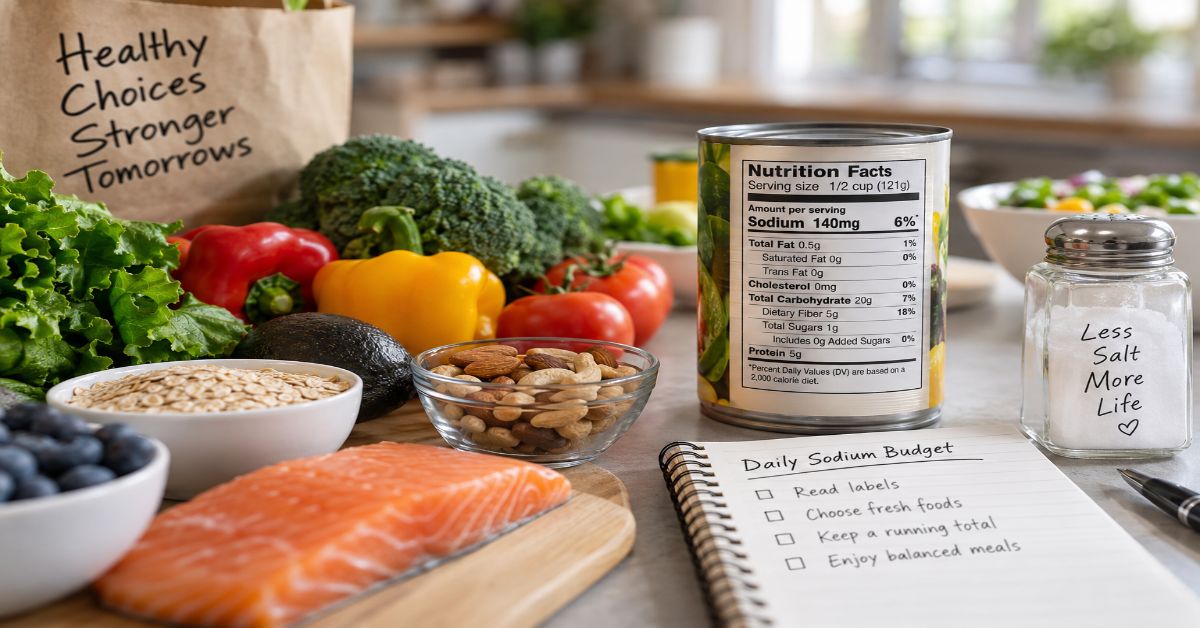
I treat a low sodium diet as a daily sodium budget, not a punishment menu: for most people age 14 and older, current U.S. guidance says to stay below 2,300 milligrams of sodium a day, while some adults are advised to aim lower. The catch is that more than 70% of the sodium Americans eat comes from packaged, prepared, and restaurant food, so the salt shaker is often not the main problem.
That changes how I approach the whole topic. The useful question is not simply, “Which foods are salty?” It is, “Which foods quietly spend most of my daily sodium before dinner?” Bread, sauces, deli meat, cheese, soups, frozen meals, restaurant seasoning, and even foods marketed as healthy can consume a large part of the budget without tasting aggressively salty. A plan works better when it identifies those repeat sources and replaces them one by one.
The short answer is straightforward: build most meals from minimally processed foods, compare Nutrition Facts labels, choose products with 140 mg of sodium or less per serving when a true low-sodium option makes sense, and keep a running daily total instead of judging food by taste alone. If you have heart failure, kidney disease, liver disease, take medicines that affect sodium or potassium, or lose large amounts of salt through heavy sweating, your target may need to be individualized by a clinician.
In this guide, I focus on the part that many ranking pages leave vague: how to make the numbers add up in real life, how to eat out without guessing, when salt substitutes help, and where a lower-sodium plan can create new problems if it is followed too aggressively.
What Is a Low Sodium Diet, and Who Actually Needs One?
A low sodium diet reduces sodium while still supplying the amount needed for nerves, muscles, and fluid balance. The 2025-2030 Dietary Guidelines advise people age 14 and older to stay below 2,300 mg per day. The American Heart Association identifies 1,500 mg as an optimal goal for most adults, especially when blood pressure is a concern.
I would not treat 1,500 mg as universal. Heart failure, kidney or liver disease, heavy sweat losses, and medicines that affect fluid or electrolytes can change the appropriate target.
Salt and sodium are related but not identical. Table salt is sodium chloride, and one teaspoon contains roughly 2,300 mg of sodium, so small additions across cooking, sauces, snacks, and restaurant food can accumulate quickly.
Why Does Cutting Sodium Lower Blood Pressure?
Higher sodium intake can increase fluid retention and blood volume, raising pressure inside blood vessels. Reducing sodium is therefore an established dietary tool for lowering blood pressure, although response varies by person.
A 2025 meta-analysis of 36 population-based randomized trials involving 66,803 participants found sodium-reduction interventions lowered office systolic blood pressure by 2.64 mmHg on average, with larger effects in people with hypertension (Mizuta et al., 2025). A 2026 meta-analysis also found lower home blood pressure.
I think the practical lesson is more important than chasing one perfect milligram target: a repeatable reduction is valuable. The National Heart, Lung, and Blood Institute’s DASH eating plan remains a strong template because it combines lower sodium with vegetables, fruit, whole grains, beans, nuts, fish, and low-fat dairy rather than treating sodium as an isolated nutrient.
Where Does Sodium Hide in Everyday Food?
The biggest mistake is judging sodium by taste. Sodium also serves preservation, texture, baking, and moisture functions, so mildly salty foods can still contain a lot. Packaged breads, sauces, cheese, soups, deli meats, ready meals, and restaurant food deserve close attention.
FDA label language has defined meanings. I use this table as a supermarket filter rather than trusting package colors or health-focused marketing.
| Label term | FDA meaning per serving | What it means in practice |
| Sodium-free / salt-free | Less than 5 mg | Very little sodium |
| Very low sodium | 35 mg or less | Useful for very tight meal budgets |
| Low sodium | 140 mg or less | A reliable low-sodium threshold |
| Reduced sodium | At least 25% less than the reference food | May still be high in absolute sodium |
| Light in sodium | At least 50% less than the reference food | Compare the actual milligrams anyway |
| No salt added / unsalted | No salt added during processing | Not necessarily sodium-free |
The “reduced sodium” trap
A reduced-sodium soup that drops from 900 mg to 650 mg per serving has achieved a meaningful reduction, but it is still not a low-sodium food. That distinction is one of the easiest places to gain control: compare milligrams per serving first, then use marketing terms as secondary information.
The restaurant trap
Restaurant sodium can come from marinades, seasoning blends, cheese, bread, dressings, sauces, broths, and finishing salt. If a chain publishes nutrition, I check it before arriving. Elsewhere, I ask for sauces on the side and no added salt when feasible.
That pre-meal check also fits the site’s Mexican restaurant search guide: read the menu and ask specific preparation questions instead of assuming a dish name tells the whole story.
How Can You Make a 2,300 mg Day Actually Add Up?
I find a sodium budget more sustainable than forcing every meal extremely low. It reserves sodium for foods that are worth it and cuts invisible sources that add little satisfaction.
This planning framework is not a medical prescription. It shows how one meal or packaged item can fit without consuming the daily allowance.
| Daily target | Breakfast | Lunch | Snacks | Dinner | Buffer |
| 2,300 mg | 400 mg | 600 mg | 200 mg | 800 mg | 300 mg |
| 1,500 mg | 250 mg | 400 mg | 150 mg | 550 mg | 150 mg |
The buffer absorbs small items such as bread, condiments, or an unverified restaurant preparation. Without it, a precise plan can fail in ordinary life.
Fix repeat foods before rare treats. If a daily sandwich contributes 700 mg, changing the bread, deli meat, cheese, or sauce matters more than a once-a-month dessert.
What Foods Fit Best, and Which Ones Need Comparison?
Naturally lower-sodium foods rarely need special branding. Fruits, plain vegetables, unsalted grains, dried beans, fresh proteins, eggs, and unsalted nuts can form the base. Compare labels once food is cured, canned, sauced, smoked, brined, or sold ready to eat.
| Food category | Usually easier to fit | Needs closer label or menu checking |
| Vegetables | Fresh or plain frozen vegetables | Sauced frozen vegetables, canned vegetables with salt |
| Beans and grains | Dried beans, plain rice, oats, quinoa | Seasoned packets, canned beans, instant noodles |
| Protein | Fresh fish, poultry, eggs, unprocessed meat | Deli meat, bacon, sausage, smoked or brined products |
| Dairy | Milk, plain yogurt, some fresh cheeses | Processed cheese, cottage cheese, cheese sauces |
| Snacks | Fruit, unsalted nuts, plain popcorn | Chips, pretzels, crackers, salted nuts |
| Flavor | Lemon, vinegar, herbs, garlic, spices | Soy sauce, bottled dressings, seasoning packets, bouillon |
A plant-forward pattern creates more low-sodium building blocks. The site’s Mediterranean food guide is useful with one caveat: olives, cheeses, cured foods, and restaurant dishes can still be sodium-dense.
Fresh fish also works well without salty marinades. The branzino cooking guide shows how lemon, herbs, garlic, and technique can carry flavor with less sodium.
How Do You Make Lower-Sodium Food Taste Good?
Salt does several jobs, so no single ingredient replaces it. I build layers with acid, aromatics, toasted spices, herbs, browning, and texture.
- Use lemon, lime, or vinegar at the end of cooking so acidity stays bright.
- Brown onions, mushrooms, meat, or vegetables for savory depth.
- Toast whole or ground spices briefly to make them more aromatic.
- Use garlic, ginger, chile, scallions, or fresh herbs to fit the dish.
- Add crunch with unsalted nuts, seeds, or fresh vegetables.
- Taste before salting. A dish may need acid, heat, or aroma rather than more sodium.
Taste also adapts. Registered dietitian Linda Ulerich, quoted by the National Kidney Foundation, says, “It typically takes about six to eight weeks on a low-sodium diet to get used to it.” I take that as a reason to reduce gradually.
What Are the Risks and Trade-Offs?
Potassium salt substitutes are not safe for everyone
The World Health Organization’s 2025 guideline supports potassium-containing lower-sodium salt substitutes for many adults who choose to use table salt, but it explicitly excludes people with kidney impairment and others whose conditions or medicines can reduce potassium excretion. Potassium chloride can be useful, but it is not a universal swap.
Very low sodium is not automatically better
Sodium is essential. Hyponatremia, or abnormally low blood sodium, can result from illness, medicines, fluid imbalance, and other causes. Confusion, severe headache, vomiting, seizures, or other concerning symptoms require medical care rather than DIY electrolyte correction.
Heavy sweating changes the equation
Prolonged exercise or physical work in heat can cause substantial sodium loss in sweat. The 2025-2030 Dietary Guidelines note that highly active people may benefit from more sodium to offset those losses, so strict restriction should not be applied blindly.
Low sodium does not mean nutritionally complete
A food can be low in sodium and still be high in added sugar, saturated fat, or refined starch. I use sodium as one filter inside an overall eating pattern, not as the sole score for whether a food is healthy.
A 7-Day Transition Plan for Cutting Sodium
I prefer a one-week audit because it changes repeat foods first. The goal is to find the few choices controlling most of your sodium.
- Day 1: Track a normal day from labels and restaurant nutrition. Build a baseline before changing anything.
- Day 2: Fix breakfast. Compare bread, cereal, cheese, and breakfast meat, then keep one lower-sodium swap you enjoy.
- Day 3: Fix lunch. Audit deli meat, soup, wraps, cheese, and sauces, then build one meal from fresh protein, vegetables, and a plain grain.
- Day 4: Audit soups, broths, canned foods, seasoning packets, sauces, pickles, and snacks by sodium per serving.
- Day 5: Rebuild flavor. Cook with acid, herbs, aromatics, and browning instead of a salty sauce.
- Day 6: Practice eating out. Check the menu, choose a lower-sodium format, and request sauce on the side.
- Day 7: Identify your top three repeat sources and make those swaps permanent before adding more rules.
For a special evening, the same planning approach works with the site’s date night ideas: choose the experience first, then a meal format you can manage.
The Future of Low Sodium Diets in 2027
The biggest 2027 shift may happen outside home kitchens. FDA’s Phase II voluntary sodium-reduction targets were still draft in September 2026. They cover 163 categories and, if finalized and achieved, aim to move average intake toward about 2,750 mg per day. That remains above 2,300 mg but signals continued food-supply reformulation.
WHO issued its first global lower-sodium salt-substitute guideline in 2025, while FDA has continued work that could expand manufacturers’ flexibility to use substitutes in standardized foods. More potassium chloride in products would make label reading especially important for people who must limit potassium.
Timing remains uncertain because drafts can change and manufacturers reformulate at different speeds. The defensible 2027 outlook is more reformulated choices and more reason to compare both sodium and potassium on labels, not a sudden transformation of every packaged food.
Key Takeaways
- The U.S. ceiling is less than 2,300 mg daily for ages 14+, while 1,500 mg is a common lower heart-health target.
- Big gains often come from changing repeat packaged foods and restaurant habits.
- “Low sodium” means 140 mg or less per serving; “reduced sodium” can still be high because it is a relative claim.
- A daily budget with a buffer is more realistic than making every meal nearly sodium-free.
- Potassium-based salt substitutes can help some adults, but kidney disease and medicines that impair potassium excretion require caution.
- Flavor adapts, and acid, herbs, spices, browning, and texture make the change easier to sustain.
Conclusion
A lower-sodium way of eating becomes much easier when I stop treating salt as the only variable. The real work is finding where sodium enters the day repeatedly, then deciding which sources are worth keeping and which ones are just background. For many people, that means changing bread, deli meat, soups, sauces, frozen meals, and restaurant ordering before worrying about naturally low-sodium whole foods.
The numbers matter, but the system matters more. A 2,300 mg target is easier to follow when it is divided into meals, protected by a buffer, and supported by a handful of reliable low-sodium staples. A 1,500 mg target requires tighter choices and deserves more individualized guidance, especially when heart, kidney, liver, medication, or hydration issues are involved.
I would judge success by consistency, blood-pressure response when relevant, and whether the plan still produces food you want to eat. Sodium reduction works best as a durable pattern, not a short period of flavorless restriction.
Frequently Asked Questions
How much sodium is allowed on a low sodium diet?
For most people age 14 and older, U.S. guidance says to stay below 2,300 mg per day. Some adults use 1,500 mg for blood-pressure or medical reasons. Heart, kidney, liver, medication, or heavy-sweating issues can require an individualized target.
Is 2,000 mg of sodium a day considered low sodium?
A 2,000 mg intake is below the general 2,300 mg U.S. limit and is common in clinical meal plans. Whether it is right depends on why sodium is being restricted, so it is not a universal medical target.
What foods are naturally low in sodium?
Fresh fruit, plain vegetables, unsalted grains, dried beans, fresh meat, poultry, fish, eggs, and unsalted nuts are usually low in sodium. Check labels once foods are canned, cured, smoked, brined, sauced, seasoned, or ready to eat.
Is sea salt better than table salt on a low-sodium plan?
No. Both provide sodium chloride. Crystal size can change how much fits in a spoon, but specialty salt is not a free choice. Track sodium rather than assuming sea salt is healthier.
Are potassium salt substitutes safe?
They can help many adults, but WHO’s 2025 recommendation excludes people with kidney impairment and others who may not excrete potassium normally. If kidney disease or potassium-affecting medicines apply to you, ask a clinician or pharmacist first.
How long does it take to get used to eating less salt?
Taste adaptation is gradual. The National Kidney Foundation quotes registered dietitian Linda Ulerich saying it can take about six to eight weeks. Acid, herbs, aromatics, spices, browning, and texture can keep meals satisfying while your palate adjusts.
Methodology
I researched this guide on September 12, 2026, using U.S. government guidance, cardiovascular and kidney-health organizations, the 2025 WHO salt-substitute guideline, and recent meta-analyses. I verified the U.S. ceiling against the 2025-2030 Dietary Guidelines, label definitions and policy against FDA materials, DASH context against NHLBI, and potassium exclusions against WHO.
I also reviewed 10 prominent search results. Common strengths were definitions, food lists, and general tips. Gaps included daily sodium budgeting, absolute-versus-relative label claims, restaurant decision logic, salt-substitute safety, current policy context, and a stepwise transition plan. Search rankings vary by location, device, and personalization, so this benchmark is a snapshot.
Limitations: sodium needs are individual, formulations and restaurant nutrition change, and this article cannot replace individualized medical advice. AI assistance was used in research, organization, and drafting. A human editor must review the final text, claims, links, and references before publishing.
References
American Heart Association. (2025). How much sodium should I eat per day?
National Heart, Lung, and Blood Institute. (2026). DASH eating plan.
National Kidney Foundation. (n.d.). Top 5 ways to stop a-salting your kidneys.
U.S. Food and Drug Administration. (2024). Sodium in your diet.
U.S. Food and Drug Administration. (2024). Sodium reduction in the food supply.
World Health Organization. (2025). Use of lower-sodium salt substitutes: WHO guideline.

A health and safety problem in Southall rarely announces itself as a dramatic emergency. It can start with a delivery left across a shop aisle, a pallet moved without the right equipment, a new starter who does not understand an evacuation instruction, or a contractor beginning work before anyone has checked the risks. If you searched for southall health and safety because you need training, compliance support, or a clearer idea of what your workplace should have in place, this guide is designed to help you make that decision. I have approached the topic by checking current Health and Safety Executive (HSE), GOV.UK and Ealing Council guidance, then translating the legal duties into practical steps for local employers, managers, supervisors, contractors and workers.
The key point is simple: Southall businesses do not need a random collection of certificates. They need a risk-led system that identifies hazards, controls them, gives people suitable information and training, provides competent supervision, and keeps the right records. The exact mix depends on the work being done. A small office, a busy food premises, a warehouse, a construction project and a vehicle-related operation can face very different risks and may also be enforced by different authorities.
That distinction matters when you are choosing a course or consultant. A useful provider should be able to explain why a particular training need follows from your risk assessment, not merely sell the most familiar course title. This article shows what employers must cover, which risks deserve priority, how local enforcement works in Ealing, what to check before buying training, and how to turn compliance into a working safety system rather than a folder of certificates.
What does Southall health and safety actually cover?
Southall health and safety means the practical management of workplace risks under UK law, supported by suitable training, supervision, emergency arrangements and records. For a local business, the goal is not simply to “have a certificate”; it is to show that foreseeable risks have been assessed and controlled, and that workers understand how to do their jobs safely.
That is why a Southall employer should begin with the activity and the risk, not with a course catalogue. The same business may need general induction, manual handling instruction, equipment-specific training, fire safety arrangements, first-aid provision and more specialised competence, depending on what people actually do.
Which health and safety duties apply to Southall businesses?
The Health and Safety at Work etc. Act 1974 and supporting regulations place duties on employers to protect employees and others who may be affected by their work. HSE guidance turns those duties into a manageable sequence: appoint competent help, assess risks, put controls in place, provide information and training, consult workers, monitor performance and review arrangements when circumstances change.
Risk assessment and a written health and safety policy
Every employer needs to assess workplace risks. HSE guidance says that if an organisation employs five or more people, the significant findings of the risk assessment must be recorded. The same five-employee threshold applies to putting the business health and safety policy in writing. A useful policy is not a generic statement downloaded once and forgotten. It should identify who is responsible, what arrangements are in place and how those arrangements are maintained.
A practical risk assessment asks five questions: what can cause harm, who may be harmed, how serious and likely the harm is, what controls are already in place, and what further action is needed. It should be reviewed when work changes, after incidents, when new equipment or substances are introduced, or when there is reason to believe the existing assessment is no longer valid.
Information, training and supervision
HSE states that workers must receive clear instructions and information, adequate training and appropriate supervision. Training should match the job and the risk. Low-risk office work may need straightforward induction and emergency information, while lifting equipment, work at height, hazardous substances or powered machinery can require task-specific competence. HSE also says employee health and safety training should take place during working hours and be free to employees.
Southall employers should pay particular attention to comprehension. HSE guidance on migrant workers says employers should use plain language, check understanding and consider translation where workers do not speak English well. A signed attendance sheet is weak evidence if a worker cannot explain the control measures or emergency procedure afterwards.
Fire safety and first aid
For non-domestic premises in England, the responsible person must carry out and regularly review a fire risk assessment, keep a written record, maintain suitable precautions, plan for emergencies and provide staff information and training. The assessment should consider exits, warning systems, firefighting equipment, dangerous substances and people who may need additional help during evacuation.
First-aid provision is also risk-led. HSE guidance requires employers to assess first-aid needs and provide adequate and appropriate equipment, facilities and personnel. The right answer may be an appointed person, Emergency First Aid at Work, First Aid at Work, or a more specific arrangement, depending on hazards, workforce size, working patterns and access to emergency medical help.
The following table separates the main duties from the evidence that helps demonstrate they are being managed.
| Duty or control | What a Southall employer should have | When written evidence matters |
| Risk assessment | Suitable assessment of significant hazards and controls | Significant findings must be recorded with 5 or more employees |
| Health and safety policy | Clear responsibilities and practical arrangements | Policy must be written with 5 or more employees |
| Training and supervision | Job-relevant instruction, training and competent supervision | Keep records to show who was trained and when review is due |
| Fire safety | Recorded fire risk assessment, precautions, emergency plan and training | A written fire risk assessment is required for relevant premises |
| First aid | Provision based on a first-aid needs assessment | Record the assessment and training or competence evidence where appropriate |
| Incident reporting | Internal records plus RIDDOR reporting when criteria are met | Accident book required for more than 10 employees under social security law |
Which risks should Southall workplaces prioritise?
The priority list should come from the workplace, not from a generic template. However, current HSE injury data shows why several familiar hazards deserve attention. In 2024/25, slips, trips or falls on the same level accounted for 30% of non-fatal employee injuries reported under RIDDOR, while handling, lifting or carrying accounted for 17%. Falls from height accounted for 8%.
Slips, trips and manual handling
A shop, restaurant, warehouse or office can reduce slip and trip risk through good housekeeping, prompt spill control, suitable flooring, clear walkways and sensible cable management. These controls sound basic, but they target the single largest accident category in the latest RIDDOR breakdown.
For manual handling, training alone is not the first control. HSE guidance says employers should avoid hazardous manual handling where reasonably practicable, then assess unavoidable handling and reduce the risk. That can mean changing delivery points, using trolleys or pallet equipment, reducing load size, redesigning storage heights, or changing how often a task is performed.
Work at height, machinery and hazardous substances
Where people use ladders, mobile access equipment, machinery, forklifts, cutting tools or other work equipment, competence must be proportionate to the task. A short awareness course may not be enough for equipment that requires practical skill, site familiarisation or supervised experience. Employers should check the relevant legal and industry requirements instead of assuming that any online certificate proves competence.
COSHH applies where substances hazardous to health are used or generated. A safety data sheet is useful information, but it is not itself a COSHH assessment. HSE says the assessment must be suitable and sufficient for the actual task, exposure and controls. Cleaning products, dusts, fumes, solvents and process chemicals can all require different controls.
Work-related stress, young workers and communication
Health and safety includes health, not only accidents. HSE reports that 1.9 million workers were suffering from work-related ill health in 2024/25, with stress, depression or anxiety making up 52% of those cases. Employers have a legal duty to assess and act on work-related stress risks just as they do with physical hazards.
Young or inexperienced workers, new starters, people changing roles and workers with limited English may need more supervision or different communication. The practical test is whether the person can recognise the hazard, follow the control, use equipment correctly and respond to an emergency without relying on guesswork.
What Southall health and safety training do you actually need?
There is no single training bundle that makes every Southall workplace compliant. HSE expects employers to decide what information, instruction, training and supervision are necessary from the risk assessment. Training can be delivered in-house or externally, provided it is suitable, understandable and effective.
Use the matrix below as a decision aid, not as a substitute for a workplace assessment.
| Work activity or situation | Typical training or instruction to consider | What to verify |
| All workplaces | Induction, emergency procedures, reporting hazards, role responsibilities | Worker can explain local rules and who to contact |
| Manual handling | Task-specific handling instruction and use of aids | Task has first been redesigned or assessed to reduce risk |
| Work at height | Work-at-height awareness plus equipment or task-specific competence | Practical ability, equipment checks and rescue arrangements where relevant |
| Forklifts or work equipment | Operator training, familiarisation, authorisation and supervision | Training matches equipment type and workplace conditions |
| Hazardous substances | COSHH information, control measures, PPE/RPE use where needed | Assessment reflects actual substance, exposure and task |
| Fire safety | Evacuation procedure, alarm response and role-specific training for wardens if used | Content matches the premises fire risk assessment |
| First aid | EFAW, FAW or other provision based on the needs assessment | Certificate type and coverage match workplace risk and staffing |
| Managers and supervisors | Risk management, incident investigation and supervision responsibilities | Learning is applied to the organisation’s own hazards |
Do construction and warehouse roles need more specialised training?
Often, yes. Construction and warehouse work can combine vehicle movement, lifting equipment, work at height, manual handling and high-energy machinery. The employer should identify which activities require formal qualifications, recognised operator training, practical assessment or site-specific authorisation. A general health and safety course can support awareness, but it cannot replace competence for a specific machine or high-risk task.
What about retail, hospitality and office workplaces?
Lower-risk does not mean no-risk. Retail and hospitality businesses may need controls for slips, hot surfaces, knives, manual handling, cleaning chemicals, violence, lone working and fire. Offices still need suitable workstations, safe electrical arrangements, fire procedures, first-aid provision and management of stress. The amount of training should remain proportionate rather than excessive.
How do you choose a Southall health and safety provider?
A strong provider should help you solve a defined risk or competence gap. Before booking, ask what the course is designed to achieve, who recognises the qualification if recognition matters, how competence is assessed and whether the content can be adapted to your workplace. Be cautious with vague claims such as “fully HSE approved” unless the provider can explain exactly what approval or scheme they mean. HSE sets legal expectations and publishes guidance, but many commercial course certificates are issued by training organisations or awarding bodies rather than by HSE itself.
This comparison helps distinguish useful training from certificate-led purchasing.
| Question to ask | Good evidence | Warning sign |
| Why do we need this training? | Linked to a risk assessment, legal duty or defined competence need | “Everyone needs this certificate” with no task analysis |
| Who delivers it? | Trainer experience, relevant qualification and sector competence are clear | No trainer details or only generic marketing claims |
| How is learning checked? | Practical demonstration, knowledge check or observed assessment where appropriate | Attendance alone treated as proof of competence |
| Is the certificate meaningful? | Awarding body, scheme, scope and renewal expectations are explained | Universal claims that every certificate is “HSE approved” |
| Can it fit our workforce? | Plain language, accessible delivery and translation support where needed | No method for checking understanding |
| Will it fit our site? | Examples, equipment and procedures reflect the workplace | Generic slides with no connection to local risks |
Who enforces health and safety in Southall?
Southall sits within the London Borough of Ealing, so enforcement depends on the type of workplace. Ealing Council states that its workplace and public safety team inspects businesses including offices, warehouses, shops, hotels, leisure centres and places of entertainment. It also states that construction, manufacturing, council buildings and some motor vehicle repair premises are enforced by HSE.
This matters if you are reporting a concern, responding to an inspection or seeking official guidance. Ealing Council says inspectors may enter workplaces without notice and may examine the premises, work activities, management arrangements and compliance with health and safety law. If the matter falls under HSE, the concern should be directed to HSE instead.
What happens after an accident or dangerous occurrence?
Not every accident is reportable under RIDDOR, but certain deaths, specified injuries, occupational diseases and dangerous occurrences are. HSE says most reportable incidents must be notified without delay and the report received within 10 days. An accident causing a worker to be unable to perform normal duties for more than seven consecutive days must be reported within 15 days of the incident.
Internal recording is wider than RIDDOR. HSE says organisations with more than 10 employees must keep an accident book or equivalent record under social security law. Near-miss reporting is also useful because it exposes weak controls before someone is injured.
What should a 30-day Southall health and safety action plan include?
For a business that has training certificates but no clear system, the fastest improvement usually comes from connecting documents, controls and people. A practical first month can look like this:
1. Map the work. List routine and non-routine activities, contractors, deliveries, equipment, substances and public interaction.
2. Review risk assessments. Remove obsolete assessments and update significant hazards, affected people, controls, owners and review dates.
3. Check legal basics. Confirm the health and safety policy, competent assistance, fire risk assessment, first-aid needs assessment and incident records.
4. Build a training matrix. For each role, record mandatory induction, task-specific training, authorisations, refresher triggers and supervision needs.
5. Verify competence. Observe real work rather than relying only on certificates. Correct unsafe shortcuts and document additional coaching where needed.
6. Close physical defects. Deal with blocked exits, damaged equipment, poor storage, slip hazards, missing guards or ineffective controls before buying extra classroom training.
7. Set a review rhythm. Use monthly checks for actions and incidents, then review the wider system after significant change, an accident, new equipment or new processes.
This approach creates an audit trail, but more importantly it makes the system usable. The records should reflect what actually happens on the floor, in the kitchen, at the counter, in the warehouse or on site.
What do current HSE statistics tell Southall employers?
The latest national figures give useful context for local priorities. HSE reported 126 worker deaths from work-related incidents in Great Britain in 2025/26. For 2024/25, HSE estimated 680,000 workers sustained a non-fatal workplace injury and 1.9 million workers were suffering from work-related ill health. The combined impact of work-related illness and workplace injury was estimated at 40.1 million working days lost.
These numbers argue against treating health and safety as a once-a-year compliance exercise. The strongest local system looks at both immediate accident hazards and slower health risks such as stress, musculoskeletal strain and harmful exposure. It also measures leading indicators, such as overdue actions, failed equipment checks, repeated near misses and gaps in supervision, rather than waiting for injury statistics to reveal a problem.
Key takeaway
Good Southall health and safety management starts with one question: what could realistically harm people here, and what evidence shows that risk is controlled? Training is part of the answer, but only when it is tied to the job, understood by the worker, supported by supervision and backed by safe equipment and procedures. If you choose courses or consultancy on that basis, you are far more likely to build a system that works during an ordinary shift, not just during an inspection.
Frequently asked questions
Is health and safety training legally required for every employee in Southall?
Employers must provide the information, instruction, training and supervision needed for employees to work safely. The exact course or format depends on the risks, so the law does not require every employee to hold the same generic certificate.
Do I need a written risk assessment if I have fewer than five employees?
You still need to assess risks. HSE says the significant findings must be recorded when you employ five or more people. Smaller employers are not generally required to record them, although a written assessment is often useful for review and communication.
Is an online health and safety course enough for a Southall workplace?
It can be suitable for awareness topics where no practical competence is required. For equipment, high-risk activities or tasks that depend on physical skill, employers may also need practical instruction, assessment, familiarisation and supervision.
How often should health and safety training be refreshed?
There is no universal renewal period for all health and safety training. Refresh training when law or a specific scheme requires it, when competence has declined, after significant change or incidents, or when the risk assessment shows a need.
Who should I contact about an unsafe workplace in Southall?
It depends on the workplace. Ealing Council regulates many offices, warehouses, shops, hotels and leisure premises, while HSE regulates areas including construction and manufacturing. Ealing Council’s enforcement page explains the split and links to HSE reporting where appropriate.
Does a health and safety consultant take over the employer’s legal responsibility?
No. A competent consultant can advise, assess and help implement controls, but the employer or relevant duty holder retains legal responsibilities. The business should understand the recommendations, assign actions and verify that controls remain effective.
-

 Technology3 weeks ago
ThomsonKids.com: Website Guide, Topics & Trust Check
-

 General2 weeks ago
Voozon.com: What It Is and How the Platform Works
-

 Technology2 weeks ago
thesindi com Review: What TheSindi.com Really Offers
-

 Technology2 weeks ago
Cambro.tv: Status, Safety & Technical Guide
-

 Business2 weeks ago
5starsstocks.com Review: Features, Trust and Safety
-

 General3 weeks ago
My Reading Manga: What MyReadingManga Is, Safety, Legality and Better Alternatives
-

 Guide3 weeks ago
Thothub Safety Guide: What the Name Means, Link Risks and Legal Concerns
-

 Technology3 weeks ago
Iwara: What iwara.tv Is, How It Works and What to Know